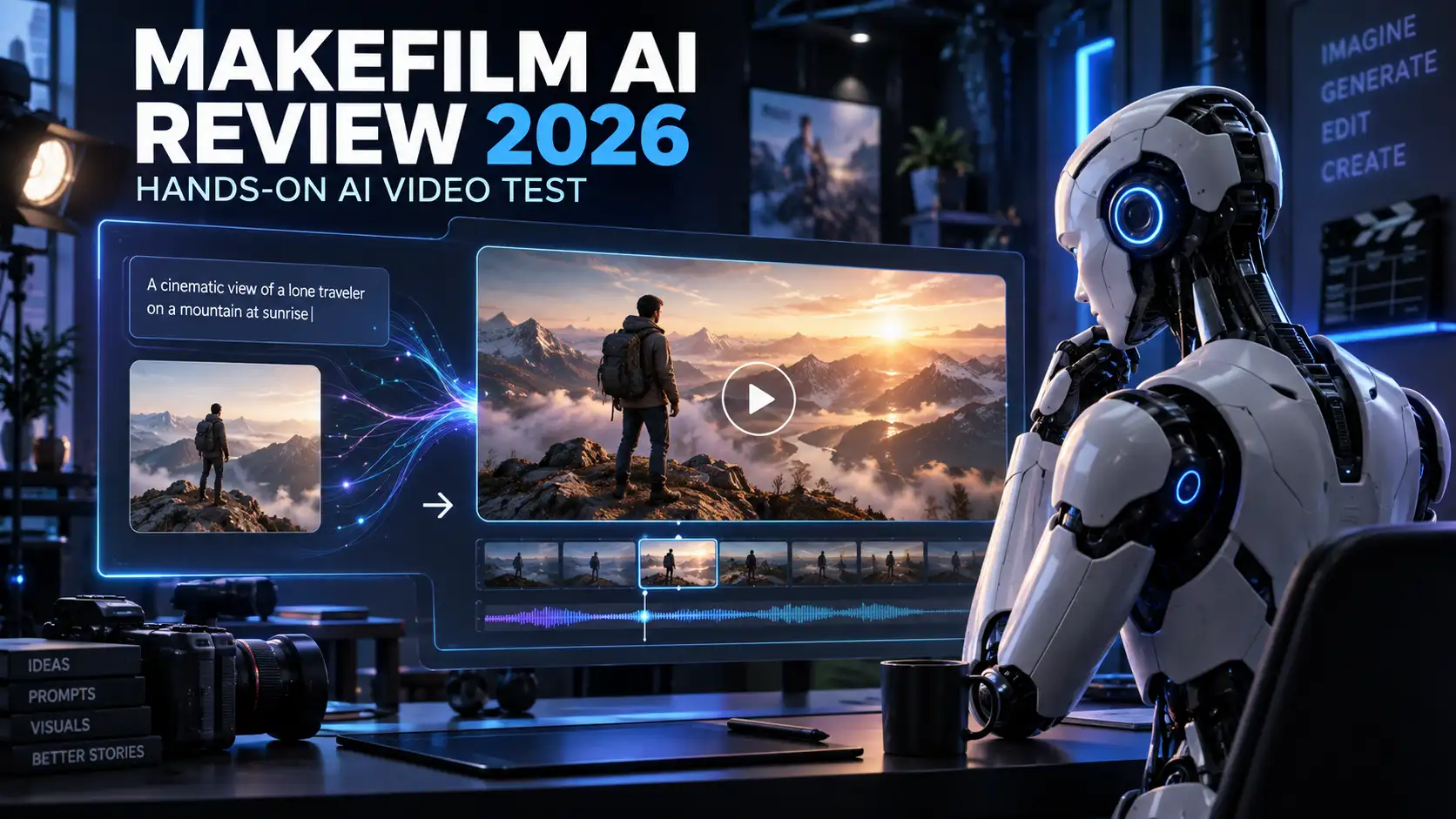

If you’ve typed “MakeFilm AI” into Google, you’re probably trying to decide whether this text-to-video and image-to-video tool is worth your time — or your money. This MakeFilm AI review answers that directly, based on a hands-on test conducted on September 12, 2026, combined with research from MakeFilm’s official site, pricing page, and legal policies.
MakeFilm AI is built for people who want a finished-looking video clip without opening a traditional editor: bloggers turning a paragraph into a promo clip, YouTubers testing short-form ideas, small businesses animating a product photo, and marketers who need a quick concept video. In our test, MakeFilm AI’s biggest strength was cinematic visual quality; its main limitation was small visual inconsistencies inside a single 10-second clip. But before you consider a plan, there’s a bigger issue this review uncovered that affects whether MakeFilm AI is worth using at all right now — covered in the Quick Verdict below.
Disclosure: This independent review combines hands-on testing with research from official sources. Features and pricing may change after publication. BlogAILab may earn a commission from qualifying links at no additional cost to you.
Important Update
While researching current pricing on September 12, 2026, we found a notice posted across MakeFilm AI’s official homepage, pricing page, and Terms of Service: “This website will stop being active after September 15, 2026. Please use your remaining credits as soon as possible. Purchases are no longer available.” This appears to mean MakeFilm AI is shutting down within days of this review’s publication and is not currently accepting new purchases. Everything below reflects what we verified on the official site as of that date. If you’re reading this after mid-September 2026, check makefilm.ai directly before doing anything else, since the service may no longer be operating.
Quick Verdict
Is MakeFilm AI worth it? Based on our test, MakeFilm AI produces genuinely good-looking short clips very quickly and without a watermark — but the platform’s own site currently states it is shutting down and no longer accepting purchases. That single fact overrides most other considerations: even if the underlying quality impressed us, this is not a tool to start paying for today. If you’ve already got credits, use them before the stated shutdown date; otherwise, treat this as a snapshot review of a tool in its final days rather than a long-term recommendation.
| Category | Detail |
| Overall rating | 8.5/10 (for output quality on the tested clip only) |
| Best for | Quick, short cinematic concept clips — while the service still operates |
| Main strength | Cinematic visual quality |
| Main limitation | Minor visual inconsistencies; site reportedly shutting down |
| Plan tested | Free trial |
| Features tested | Text-to-video, image-to-video |
| Generation time | Under one minute |
| Output resolution | 720p |
| Watermark | None on the tested output |
| Free option | Yes, historically (100 credits) — purchases currently disabled |
| Starting price | Historically $9.90/month (Lite plan); not currently purchasable |
What Is MakeFilm AI
MakeFilm AI is a web-based AI video generator that converts text prompts or still images into short video clips using generative AI models, and adds automated voiceovers and captions. Unlike a traditional video editor, it doesn’t require you to import footage, cut clips, or animate anything by hand — you describe or upload what you want, and the underlying models render motion, framing, and audio for you.
The platform is aimed at people without editing experience: bloggers, social media creators, YouTubers, musicians, small businesses, and marketers who need a short clip quickly. According to the official site, it also includes utility tools such as caption generation, text/watermark removal, and video summarization, positioning it as an all-in-one AI video suite rather than a single-purpose generator.
MakeFilm AI Features
The features below come from MakeFilm AI’s official feature and tools pages. We personally tested only text-to-video and image-to-video generation; the rest are listed as available on the site but were not part of our hands-on test.
Text-to-Video Generator (personally tested)
MakeFilm AI’s text-to-video tool — branded on-site as the “Instant Video Wizard” — turns a written prompt into a short clip with AI-selected shots, voiceover, and subtitles. It’s useful for bloggers and marketers who want a concept video from a paragraph of description rather than raw footage. In our test, it followed the main idea of the prompt well, though it missed a few smaller details. A practical limitation: because you don’t control individual shots, precise creative direction is harder than in a manual editor.
Image-to-Video Generator (personally tested)
This tool animates a still photo with motion, transitions, and effects — for example, turning a product photo into a moving showcase clip. It’s well suited to small businesses animating product shots or creators bringing a single image to life for social posts. In our test, motion was generally smooth with only minor issues, and the original subject stayed mostly recognizable throughout the clip.
AI Image Generator (verified from official site, not tested)
MakeFilm AI’s site lists a standalone image generator supporting styles such as realism, anime, 3D, and oil painting, with built-in upscaling. This could be useful for creators who want a source image to animate with the image-to-video tool. We did not personally test this feature.
AI Voice Generator (verified from official site, not tested)
The official site describes a voice generator with a library of voices across languages and accents, with tone, tempo, and accent controls. This is company-described functionality we did not personally verify in our test.
AI Music Video Generator (company claim, not tested)
MakeFilm AI’s site links to a dedicated “AI Music Video Generator” tool page aimed at musicians who want a video to accompany a track. We were not able to test this feature and cannot verify its output quality.
Subtitles and Captions (verified from official site, not tested)
A caption generator is listed as producing timed, multi-language subtitles automatically. This is a commonly requested feature for accessibility and social media, but we did not personally test its accuracy.
Specialized Video Templates (verified from official site, not tested)
The site includes purpose-built landing pages and tools for use cases like video memes, lyric videos, and holiday-themed clips. These function more like guided templates than a traditional template library, and we did not test them directly.
Text and Watermark Removal (verified from official site, not tested)
MakeFilm AI also advertises a tool that removes existing text or watermarks from uploaded video footage — a separate function from generating new video. We did not test this tool.
How to Use MakeFilm AI
- Visit MakeFilm AI at Official website
- Create an account or log in (MakeFilm AI’s Terms of Service require users to be at least 18).
- Choose a generation feature — for example, text-to-video or image-to-video — from the workspace.
- Enter a text prompt describing your video, or upload an image to animate.
- Select whatever generation settings are available for your plan (settings shown may vary; we did not verify a full list of adjustable parameters).
- Generate the video and wait for processing.
- Review the result in the preview player.
- Download the finished clip as an MP4 file.
My MakeFilm AI Test
We chose a short 10-second test because it’s enough to evaluate prompt-following, motion, and visual consistency without relying on MakeFilm AI’s longer-form capabilities, which we did not test. The concept we used was a futuristic product-visualization scene: a simple text prompt entering an AI processing environment and transforming into a finished cinematic video, ending with the on-screen text “MAKEFILM AI” and a subtitle.
I tested MakeFilm AI’s text-to-video and image-to-video features using its free trial on September 12, 2026. The 10-second video was generated in under a minute and downloaded as a watermark-free 720p MP4. It followed the main concept well and produced cinematic visuals with generally smooth motion. However, I noticed a few minor inconsistencies in the generated scene.
Test conditions: free trial plan, 10-second requested duration, MP4 export.
Result: generation completed in under one minute, output resolution was 720p, and no watermark was present on the download. The on-screen text “MAKEFILM AI” and its subtitle rendered correctly and legibly.
Strengths observed: cinematic lighting and composition, smooth camera-style motion, and accurate text rendering.
Limitations observed: small elements of the scene shifted or changed slightly between frames, and a few finer prompt details (secondary background elements) weren’t reflected in the final clip.
| Test criterion | Observation | Score |
| Prompt accuracy | Main concept followed; some minor details missed | 8/10 |
| Motion quality | Generally smooth with minor issues | 8/10 |
| Visual consistency | Mostly consistent with a few small changes | 7.5/10 |
| Text rendering | Main title and subtitle appeared correctly | 9/10 |
| Generation speed | Completed in under one minute | 9.5/10 |
| Output quality | Cinematic 720p MP4 | 8.5/10 |
| Overall rating | Balanced overall assessment | 8.5/10 |
Media placements for this section:
- `[Insert screenshot: MakeFilm AI dashboard]` — File name: `makefilm-ai-dashboard-overview.jpg`. Alt text: “MakeFilm AI dashboard showing video generation tools.” Caption: “The MakeFilm AI workspace where text-to-video and image-to-video tools are accessed.”
- `[Insert screenshot: Text-to-video prompt and settings]` — File name: `makefilm-ai-text-to-video-prompt.jpg`. Alt text: “Text-to-video prompt entry screen in MakeFilm AI.” Caption: “Entering a prompt for MakeFilm AI’s text-to-video generator during testing.”
- `[Insert screenshot: Image-to-video upload and settings]` — File name: `makefilm-ai-image-to-video-upload.jpg`. Alt text: “Image upload screen for MakeFilm AI’s image-to-video tool.” Caption: “Uploading a source image to animate with MakeFilm AI.”
- `[Embed video: Original 10-second MakeFilm AI result]` — File name: `makefilm-ai-test-output-10-second.mp4`. Alt text: “10-second AI-generated video created with MakeFilm AI.” Caption: “Our original 10-second test clip generated on MakeFilm AI’s free trial.”
- `[Insert screenshot: Example of minor visual inconsistency]` — File name: `makefilm-ai-visual-inconsistency-example.jpg`. Alt text: “Frame comparison showing a minor visual inconsistency in MakeFilm AI output.” Caption: “A close-up of the small visual shift we observed during testing.”
MakeFilm AI Video Quality
Based on our single 10-second test, the output showed good sharpness and a cinematic look, with lighting that felt intentional rather than flat. Motion was generally smooth, without noticeable flickering, though the scene had a few small unwanted changes to background details between frames — this is the main quality issue we’d flag. Text rendering was accurate, correctly displaying both the requested title and subtitle. Object and background consistency was good but not perfect.
Whether this output is “suitable” for a given use depends heavily on the use case, and our conclusions here are limited to a single short clip:
- Blog promotion: Likely fine — resolution and visual polish are more than adequate for embedding in a blog post.
- Social media: Likely fine for short-form platforms where 720p is acceptable.
- YouTube: Usable for short segments, though 720p is below what many channels now use for full videos.
- Music videos: Possible for short cutaways, but we did not test the AI Music Video Generator specifically.
- Advertisements: Possible for concept testing, but commercial-use terms should be confirmed before running paid campaigns (see the Safety and Legit section below).
- Client projects: Requires caution given the minor inconsistencies we observed and the uncertainty around the platform’s continued availability.
- Professional filmmaking: Not something we can recommend based on a 10-second free-trial test; this use case would require far more extensive testing we did not perform.
MakeFilm AI Pricing
Pricing and plan details were checked on September 12, 2026. Visit MakeFilm AI’s official pricing page for the latest information — though note the shutdown notice above.
The following prices were recorded during research on September 12, 2026. The pricing URL now redirects to the homepage, so this table is a historical snapshot rather than a current offer:
| Plan | Listed price | Credits or limits | Resolution | Watermark | Best for |
| Free | $0/mo | 100 credits | Not specified on pricing page | Not specified on pricing page (our test showed none) | Trying the platform |
| Lite | $9.90/mo | 200 credits/month, up to ~8 videos | Not specified | Listed as “no-watermark outputs” | Occasional creators |
| Pro | $29/mo (up to $29 at max slider) | Up to 800 credits/month, up to ~53 videos (V2 model) | Not specified | Listed as “no-watermark outputs,” priority support | Regular creators |
| One-time credits | From $11.88 | 200 permanent credits (~13 videos) | Not specified | Not specified | Occasional top-ups |
However, as noted above, the MakeFilm AI homepage, pricing page, and Terms of Service all currently display a notice stating the site will stop being active after September 15, 2026, and that purchases are no longer available. Treat the pricing table above as historical reference rather than an offer you can currently purchase.
Free plan/trial:
Historically included 100 credits; our free-trial test produced a watermark-free 720p clip, though the platform’s own marketing copy lists “no-watermark outputs” as a paid-plan feature — a discrepancy worth noting.
Credit system:
Credits are consumed per generation and reset each billing cycle for subscription plans; one-time “Permanent Credits” don’t expire and can be bought without a subscription, according to the pricing page FAQ.
Maximum duration and export formats:
MakeFilm AI’s pricing page does not specify a maximum video duration or list of export formats. This information could not be independently verified at the time of publication.
Commercial-use rights:
MakeFilm AI’s Terms of Service state that users “generally own the unique assets you create using the Service,” but the same Terms grant MakeFilm AI a broad, perpetual license to use your content (including for AI training). We did not find an explicit tier-gated “commercial license” clause like some competitors publish, but you should read the Terms of Service yourself before using output commercially.
Subscription renewal and refunds:
Subscriptions auto-renew, per Section 10.1 of the Terms of Service. Per Section 10.3, refunds are only offered for service downtime or unauthorized charges, not for dissatisfaction with AI output quality, and must be requested within 7 days.
Potential additional costs:
One-time “Permanent Credit” top-ups are available as an alternative to upgrading a subscription, according to the pricing page.
MakeFilm AI Pros and Cons
Pros:
- Fast generation during our test (under one minute for a 10-second clip)
- Cinematic visual quality
- Generally smooth motion
- Correct rendering of the requested on-screen title and subtitle
- Watermark-free downloaded test output
Cons:
- Some smaller prompt details were missed
- Minor visual inconsistencies appeared within the clip
- The tested output was limited to 720p
- Only a short 10-second output was evaluated
- The official site currently states the service is shutting down and not accepting new purchases
Who Should Use MakeFilm AI
- Bloggers: Could use it for short embedded clips, if the service remains available.
- Social media creators: The short, cinematic style suits vertical or short-form content.
- YouTubers: Useful for testing concepts or short segments, less so for full-length production at 720p.
- Musicians: The dedicated AI Music Video Generator tool may be relevant, though we did not test it.
- Small businesses: Image-to-video could animate product photos quickly.
- Digital marketers: Useful for rapid concept testing, pending confirmation of commercial-use terms.
- Beginners: The prompt-based workflow requires no editing skills.
- Professional filmmakers: Not a strong fit based on our limited test; resolution and control are below what professional production typically requires.
Who Should Not Use MakeFilm AI
Given the platform’s own shutdown notice, anyone considering a new paid subscription, anyone needing long-term storage of generated assets, or anyone building a workflow that depends on MakeFilm AI staying online should hold off. Businesses needing 4K output, precise shot-by-shot creative control, or guaranteed long-form video support should also look elsewhere, since none of these were confirmed as available features.
Is MakeFilm AI Safe and Legit
MakeFilm AI’s site uses HTTPS, and it publishes a Terms of Service, Privacy Policy, and Return Policy, all linked from the site footer. The company behind it identifies itself as SAME JOY TECHNOLOGY PTE. LTD., registered in Singapore, and the Privacy Policy states it’s designed to comply with GDPR and CCPA.
A few points worth knowing before you decide is MakeFilm AI safe for your own use:
- The Terms of Service grant MakeFilm AI a broad, perpetual, worldwide license to use content you upload or generate, including for training and improving its AI models.
- The Terms of Service restrict access for residents of mainland China, Hong Kong, Macau, Singapore, and India — worth checking if you’re located in one of these regions.
- The Terms require users to be at least 18 years old.
- Refunds are limited to service downtime or unauthorized charges, not output quality, per the Return Policy.
- The Terms state that the company cooperates with law enforcement and may disclose relevant user information when required by law or necessary to prevent imminent harm.
We can’t independently verify how MakeFilm AI’s data-handling practices are enforced in operation, and this review is not legal advice — read the Terms of Service and Privacy Policy yourself, particularly given the platform’s stated wind-down.
MakeFilm AI Alternatives
| Tool | Best for | Major advantage | Main limitation | Free option | Starting price |
| Runway | Creative professionals wanting fine motion control | Broad, actively maintained model lineup and editing tools | Credit-based pricing can run out quickly on lower tiers | Yes (125 one-time credits) | ~$12/mo (annual) |
| Pika | Social-first, effects-driven short clips | Distinctive “Pikaffects” not replicated elsewhere | Commercial use and watermark-free exports often gated to paid tiers | Yes | ~$8–10/mo (annual) |
| Kling AI | Creators wanting a generous daily free allowance | Strong per-clip pricing at higher tiers | Free tier credits expire daily and carry a watermark | Yes (daily credits) | ~$10/mo |
| InVideo AI | Marketers who want templates, stock media, and avatars alongside AI generation | Combines AI generation with a full template/stock library | Paid tiers are pricier than pure generation tools | Yes | ~$20–28/mo |
Pricing across all four alternatives changes frequently and varies by billing cycle and region — confirm current rates on each official site before subscribing. This information could not be fully reconciled across sources at the time of publication, so treat the figures above as approximate.
MakeFilm AI vs Runway
Ease of use: MakeFilm AI’s prompt-to-video workflow is simpler and more beginner-friendly; Runway has more controls, which means a steeper learning curve.
Generation quality: Our single MakeFilm AI test scored well on cinematic look and motion smoothness; Runway is widely regarded for stronger fine-grained motion and camera control, though we didn’t run a side-by-side test.
Creative control: Runway offers more granular settings (camera movement, model selection, editing tools); MakeFilm AI’s controls were not fully documented on its site.
Available features: MakeFilm AI bundles voice, captions, and a wider set of niche tools; Runway focuses more tightly on generation and editing.
Free access: Both offer a free tier, though MakeFilm AI’s is currently not accepting purchases beyond it, per the site notice.
Pricing: Runway’s paid tiers start around $12/month (annual); MakeFilm AI’s historical entry price was lower ($9.90/month) but is not currently purchasable.
Recommendation: If you want a tool with an active roadmap and more creative control, Runway is the safer long-term choice right now. If you only need to use up existing MakeFilm AI credits before its stated shutdown, it’s reasonable to do so for quick concept clips.
Is MakeFilm AI Worth It
Based on our 10-second test alone, MakeFilm AI performed well: fast generation, no watermark, good visual quality, and accurate text rendering, with only minor issues in prompt detail and scene consistency. If judged purely on output quality at the free-trial level, it’s a solid score — hence the 8.5/10 rating for the tested clip.
But “worth it” also depends on whether you can actually use the product going forward, and that’s where this review has to be blunt: MakeFilm AI’s own site currently states it is shutting down after September 15, 2026, and that purchases are disabled. Compared with actively maintained alternatives like Runway, Pika, Kling AI, or InVideo AI — all of which currently support new sign-ups and payments — MakeFilm AI is not a tool we can recommend starting a paid relationship with today. If you already have an account with unused credits, it’s worth using them before the stated cutoff. If you’re starting from scratch, an alternative with confirmed ongoing support is the lower-risk choice.
Final Verdict
Best use case: Quick, short cinematic concept clips from a prompt or a single image — useful while the platform remains operational.
Main advantage: Fast, watermark-free generation with genuinely cinematic visual quality in our test.
Main limitation: Minor visual inconsistencies in testing, plus a site-wide notice indicating MakeFilm AI is shutting down and no longer accepting purchases.
Who should try it: Existing users with unused credits, or anyone curious about a quick, no-cost test before the stated shutdown date.
Who should choose an alternative: Anyone planning to pay for an ongoing subscription, build a recurring workflow, or rely on long-term access should choose an actively maintained tool like Runway, Pika, Kling AI, or InVideo AI instead.
Final rating: 8.5/10 — for output quality on the tested clip only, not as a durability or long-term-value score, given the platform’s current status.
If you’re building any kind of ongoing AI content workflow — whether it’s video, blog posts, or a mix — it’s worth reading our guide to how to write better AI prompts and our AI blog writing workflow so you’re not caught off guard the next time a tool changes course. And since claims like MakeFilm AI’s “1M+ active users” statistic are common in this space, our guide on how to fact-check AI-generated content is a useful companion read.
Frequently Asked Questions
-
What is MakeFilm AI?
MakeFilm AI is a web-based AI video platform that turns text prompts or still images into short video clips, with added voiceover and caption tools. It’s designed for creators without video editing experience who want a quick, prompt-driven way to produce short clips.
-
Is MakeFilm AI free?
MakeFilm AI has historically offered a free plan with 100 credits, and our free-trial test produced a watermark-free clip. However, as of September 12, 2026, the official site states that purchases are no longer available and the service is scheduled to stop operating after September 15, 2026.
- How much does MakeFilm AI cost?
MakeFilm AI’s pricing page has listed a Lite plan at $9.90/month and a Pro plan up to $29/month, plus one-time credit packs from $11.88. These prices are not currently actionable, since the site states purchases are disabled ahead of a planned shutdown.
-
Does MakeFilm AI add a watermark?
Our free-trial test produced a 720p MP4 with no visible watermark, though MakeFilm AI’s own marketing copy lists “no-watermark outputs” as a paid-plan feature. This inconsistency could not be fully resolved from public information.
-
Can MakeFilm AI create videos from images?
Yes. We personally tested MakeFilm AI’s image-to-video tool, which animates a still photo with motion and effects, and found the motion generally smooth with only minor issues.
-
Can MakeFilm AI videos be used commercially?
MakeFilm AI’s Terms of Service say users generally own the assets they create, but grant the company a broad license to your content. There’s no clearly documented commercial-use tier like some competitors publish. Review the Terms of Service yourself before commercial use.
-
Is MakeFilm AI safe?
MakeFilm AI uses HTTPS and publishes a Terms of Service, and a Privacy Policy referencing GDPR and CCPA compliance. We can’t guarantee absolute safety, and given the site’s stated shutdown, we’d be cautious about storing new personal data there.
-
How long does MakeFilm AI take to generate a video?
In our test, a 10-second video generated in under one minute on the free trial plan. This may vary by feature, prompt complexity, and current plan.
-
What are the best MakeFilm AI alternatives?
Based on our research, actively maintained alternatives include Runway, Pika, Kling AI, and InVideo AI, each with different strengths in motion control, effects, free credits, or template libraries.
-
Is MakeFilm AI worth it?
The output quality we tested was good, but MakeFilm AI’s official site currently states it is shutting down after September 15, 2026, and is not accepting new purchases. We can’t recommend starting a paid subscription right now; an actively maintained alternative is the safer choice for ongoing use.