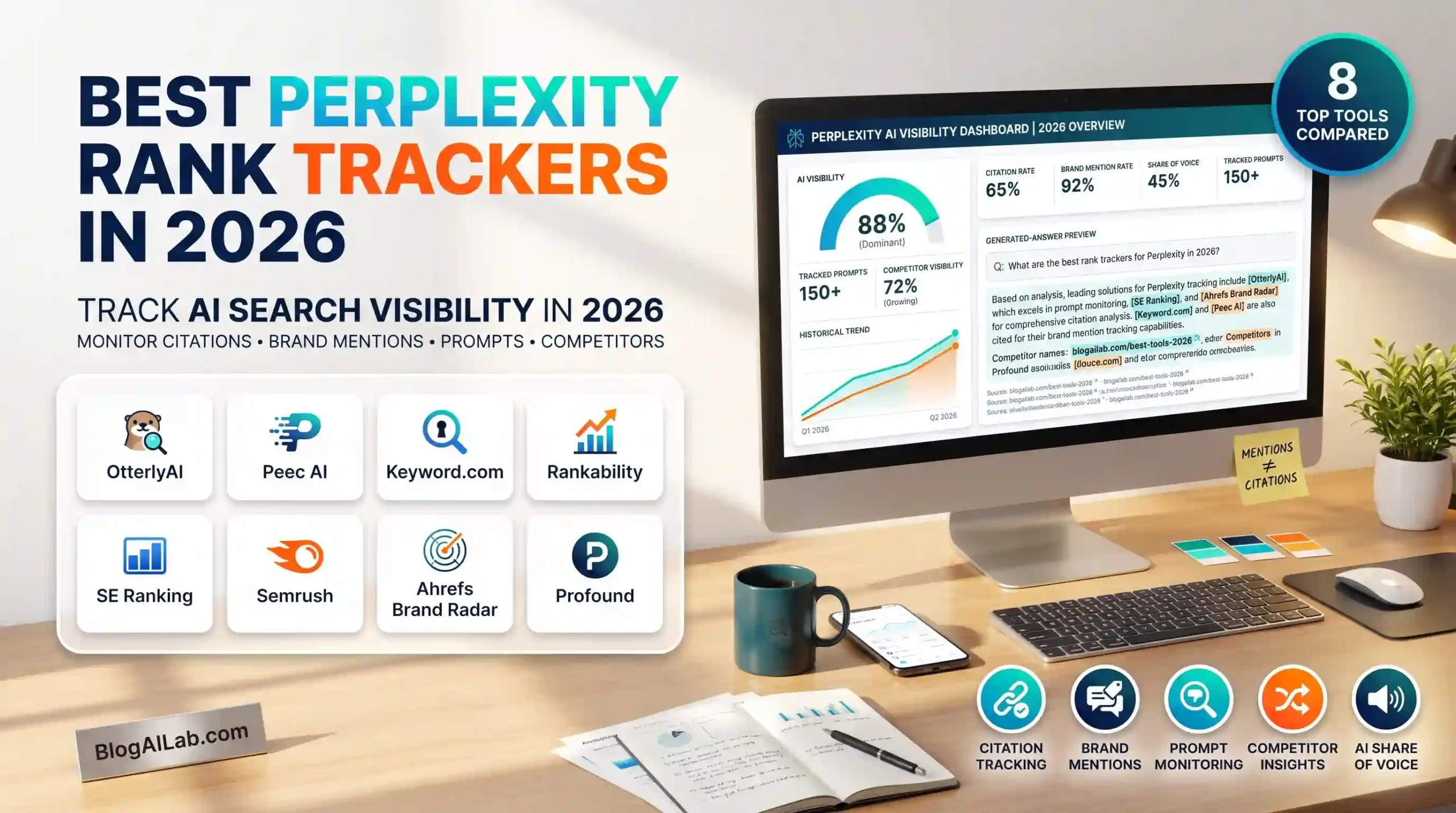

Choosing the Best Perplexity Rank Tracker is harder than selecting a conventional Google rank tracker. Perplexity does not consistently return a fixed list of ten blue links. Instead, it generates an answer that may mention a brand, cite a page, ignore both, or produce a different response when the same prompt runs again.
Consequently, buyers need to look beyond a single “rank” number. A useful tracker should reveal which prompts trigger a brand mention, which URLs receive citations, how competitors compare, and whether visibility changes over repeated runs. This guide compares eight current tools using official feature documentation and pricing checked in August 2026. It also explains what each platform measures, where its limitations lie, and which option suits bloggers, agencies, SEO teams, and larger organizations. If you also monitor Google’s AI assistant, use this separate guide to track brand mentions in Gemini.
Best Perplexity Rank Tracker: Quick Picks
- Best overall for specialist AI visibility tracking — Peec AI: Daily prompt monitoring, competitor comparisons, multi-country options, and reporting provide a strong balance for established marketing teams.
- Best for bloggers and small businesses — OtterlyAI: Its $29 monthly entry plan offers a relatively accessible route into daily Perplexity mention and citation monitoring.
- Best budget option combining Google and AI tracking — Keyword.com: The unified plan starts at $33 per month and combines conventional SERP tracking with limited AI visibility credits.
- Best for agencies managing SEO and GEO together — SE Ranking: It connects AI monitoring with an established SEO platform, competitor research, reporting, and optional agency features.
- Best for enterprise-scale research — Ahrefs Brand Radar: Its large prompt database, multi-platform indexes, custom prompts, and Ahrefs integration suit teams that can justify its higher cost.
These are use-case recommendations rather than one universal ranking. An independent blogger does not need the same prompt volume or reporting infrastructure as a multinational brand.
What Is a Perplexity Rank Tracker?
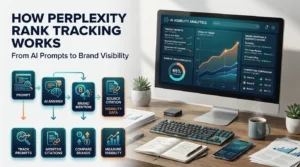
A Perplexity rank tracker monitors how a brand, domain, page, or competitor appears in Perplexity’s generated answers. Depending on the product, it may record mentions, linked citations, cited URLs, prompt-level visibility, sentiment, answer placement, share of voice, and changes over time.
Traditional SEO tracking usually follows: Keyword → ranking URL → numerical Google position.
Perplexity tracking more often follows: Prompt → generated answer → brand mention and/or cited source.
This difference matters. Perplexity can generate a new response whenever a prompt runs, and its source arrangement may change. Therefore, a displayed “average position” can be useful, but buyers should not interpret it as identical to a stable Google position.
- Does Perplexity mention my brand?
- Does it link to my website?
- Which of my pages receive citations?
- Which competitors appear more often?
- Is the pattern improving across repeated runs?
These measurements form part of a broader strategy to boost visibility in AI search
What Should a Good Perplexity Rank Tracker Measure?
- Citations — Linked sources used or displayed in an answer.
- Cited URLs — The precise pages receiving those citations.
- Brand mentions — References to a brand, even when no brand-owned URL is linked.
- Tracked prompts — Questions monitored repeatedly under consistent settings.
- Visibility trends — Changes in appearances across a selected period.
- Competitor visibility — Mentions and citations earned by competing brands.
- Share of voice — A platform-specific estimate of visibility relative to competitors.
- Historical answers — Stored responses or evidence from earlier checks.
- Geographic differences — Changes associated with countries or markets where supported.
A standalone rank number misses much of this context. A brand could appear early in an answer but receive no link. Conversely, its website might supply a citation even when the brand name does not appear prominently.
How We Evaluated the Best Perplexity Rank Trackers
This comparison uses publicly documented information rather than first-hand testing. Each platform had to confirm current Perplexity support through an official product, feature, pricing, or help page.
- Perplexity support
- Citation and linked-page tracking
- Brand mention monitoring
- Custom prompt tracking
- Competitor comparison
- Additional AI engines
- Geographic or market options
- Historical trends and reporting
- Public pricing and trial availability
- Suitability for its intended buyer
Feature statements represent documented vendor capabilities. Claims about accuracy, ease of use, or optimization results should be treated as vendor claims unless independently validated.
Best Perplexity Rank Tracker Tools Compared
| Tool | Best For | Perplexity Tracking | Citation Tracking | Other AI Engines | Starting Price* |
| OtterlyAI | Bloggers and small teams | Yes | Yes | ChatGPT, Google AIO, Copilot; add-ons | $29/mo |
| Peec AI | Specialist AI analytics | Yes | Yes | ChatGPT, Gemini, AIO, AI Mode, Copilot | $95/mo; $80 annual |
| Keyword.com | Google + AI tracking | Yes | Yes | ChatGPT, Gemini, Claude, AIO, DeepSeek | $33/mo |
| Rankability | Agency content workflows | Yes | Yes | ChatGPT, Gemini, Google AIO | $99/mo |
| SE Ranking | SEO and GEO agencies | Yes | Yes | ChatGPT, AIO, AI Mode; plan dependent | AI add-on $89/mo |
| Semrush | Existing Semrush teams | Yes | Yes | ChatGPT, Google AI, Gemini and others | $99/domain/mo annual |
| Ahrefs Brand Radar | Enterprise research | Yes | Yes | ChatGPT, Gemini, Copilot, Google AI | $199/mo one index |
| Profound | Enterprise programs | Yes | Yes | Multiple answer engines | Contact sales |
*Pricing checked in August 2026. Plans and prices may change. Verify current pricing on the provider’s website. Annual prices may require upfront annual billing.
OtterlyAI — Best for Bloggers and Small Teams
OtterlyAI offers one of the lowest publicly documented entry prices among specialist trackers. It suits buyers who want recurring prompt, mention, and citation monitoring without purchasing a large traditional SEO platform.
Key Features
- Daily prompt tracking
- Brand mention monitoring
- Citation and source-link analysis
- Competitor visibility reports
- Report exports
- Unlimited team members on documented plans
- Four core AI search engines on standard plans
Perplexity Tracking
OtterlyAI monitors selected prompts in Perplexity and records brand appearances and citations. Its documentation also distinguishes text mentions from linked citations.
Other AI Engines
Core coverage includes ChatGPT, Google AI Overviews, Perplexity, and Microsoft Copilot. Claude, Gemini, and Google AI Mode are optional add-ons.
Pricing
According to the official OtterlyAI pricing page, the Lite plan starts at $29 per month. Lite costs $29 per month for 15 prompts; Standard is $189 for 100 prompts; Premium is $489 for 400 prompts. Enterprise pricing is custom, with packages indicated from $1,000 monthly. Annual discounts and a free trial are available; there is no permanent free plan.
Best For
Bloggers, small businesses, and compact marketing teams with a manageable set of high-value prompts.
Limitations
The 15-prompt Lite allowance can become restrictive. Some notable AI engines also require paid add-ons.
Verdict
OtterlyAI is the strongest small-site option when affordability and recurring monitoring matter. Estimate required prompts and engines before choosing Lite based on price alone.
Peec AI — Best Overall for Specialist AI Visibility Analytics
Peec AI focuses specifically on AI-search measurement rather than combining it with a large traditional SEO suite. Its documented mix of daily tracking, citations, competitors, sentiment, countries, and team access creates a balanced package.
Key Features
- Daily custom-prompt tracking
- Citation and source analysis
- Brand mention rate
- Competitor benchmarking
- Share-of-voice reporting
- Sentiment analysis
- Multi-country support on higher plans
- Looker Studio integration on Advanced
- Agency-specific plans
Perplexity Tracking
Peec monitors brand appearances for selected prompts, the sources cited, and competitor performance. Agency documentation lists mention rate, citation count, average position, and sentiment. Average position remains a vendor-defined placement metric, not a conventional SERP position.
Other AI Engines
Coverage includes ChatGPT, Perplexity, Gemini, Google AI Overviews, Google AI Mode, and Microsoft Copilot. Brand plans limit the number of selected models.
Pricing
Starter is $95 monthly or $80 per month with annual billing and includes 50 prompts, three models, unlimited users, daily checks, and one project. Pro is $245; Advanced is $495; Enterprise pricing is custom. A trial is available, but no permanent free plan is advertised. Buyers can compare the latest limits and billing options on the official Peec AI pricing page
Best For
In-house SEO, GEO, and content teams needing specialist daily visibility analytics and collaboration.
Limitations
Starter covers only one project and three models. More engines, countries, or client accounts can raise the effective cost.
Verdict
Peec AI is the best overall specialist here because it covers the principal buyer requirements without requiring a broader SEO subscription. OtterlyAI remains more economical for limited tracking.
Keyword.com — Best for Combining Traditional and AI Rank Tracking
Keyword.com is relevant to buyers who still need conventional Google position tracking. Teams can combine SEO and AI-search measurement within one service.
Key Features
- Perplexity prompt monitoring
- Citation tracking
- Brand mentions
- Competitor citations
- Visibility history
- Sentiment monitoring
- Flexible scheduling
- Traditional and local Google rank tracking
Perplexity Tracking
Keyword.com documents Perplexity citations, brand appearances, competitor tracking, prompt-level inclusion, and history. It also supports selection among Perplexity Sonar models.
Other AI Engines
Official documentation mentions ChatGPT, Gemini, Claude, Google AI Overviews, DeepSeek, and other platforms. Availability and credit consumption should be confirmed during plan selection.
Pricing
The combined 360° Visibility plan starts at $33 per month and includes 1,000 Google keywords plus 15 AI visibility credits. Separate and add-on configurations also exist. A free trial is available, not a permanent free tracker.
Best For
SEO professionals wanting Google positions and Perplexity visibility in one reporting environment.
Limitations
The entry package has relatively few AI credits. Credit pricing can also be harder to compare with fixed prompt allowances.
Verdict
Keyword.com offers compelling entry pricing for combined SEO and AI tracking. It is less attractive if the only need is high-volume daily Perplexity monitoring.
Rankability — Best for Agencies Connecting Insights With Content Work
Rankability positions its tracker within a broader content research and optimization workflow, helping agencies move from detecting a citation gap to researching related content.
Key Features
- Perplexity citation history
- Brand and competitor extraction
- Prompt monitoring
- Volatility alerts
- Source-level analysis
- AI visibility summaries
- Connected content research and optimization
Perplexity Tracking
Rankability documents citation history, competitors, sources, and monitoring across selected Perplexity prompts. These capabilities go beyond a generic visibility score.
Other AI Engines
The vendor documents tracking for ChatGPT, Google AI Overviews, Gemini, and Perplexity. Verify any additional engine before subscribing.
Pricing
The official Perplexity tracker page lists the relevant package at $99 per month. Broader suite and annual pricing may differ.
Best For
Content agencies and SEO teams seeking research, monitoring, and content optimization in one workflow.
Limitations
Teams with an existing optimizer may pay for overlapping capabilities. Public information also documents less geographic depth than some specialists.
Verdict
Rankability offers more than passive monitoring, which may reduce agency workflow fragmentation. Citation-only buyers can find narrower, cheaper products.
SE Ranking — Best for Agencies Managing SEO and GEO Together
SE Ranking combines established SEO functions with an AI Search add-on. It is logical for agencies needing rank tracking, auditing, competitive research, integrations, and client reporting.
Key Features
- Perplexity mentions and links
- Custom prompt tracking
- Competitor comparisons
- Historical visibility
- Country and language analysis
- Sentiment trends
- AI competitor research
- Scheduled and white-label reporting
- Traditional SEO toolkit
Perplexity Tracking
SE Ranking documents brand mentions, website links, competitors, answer texts, historical changes, and country-specific Perplexity responses. It explicitly treats mentions and links as different measurements.
Other AI Engines
The AI Search Toolkit documents ChatGPT, Perplexity, Google AI Overviews, and Google AI Mode. Some pages also reference Gemini, depending on module or plan.
Pricing
The AI Search add-on is $89 monthly or $71.20 per month with annual billing, with a displayed 200-prompt allowance. Buyers should verify whether a base subscription is also required. A 14-day no-card trial is advertised. Current subscription and add-on details are available on the official SE Ranking pricing page
Best For
Agencies consolidating conventional SEO tracking and AI-search visibility with client reporting.
Limitations
Its pricing structure requires attention because core SEO, Agency Pack, API, and AI Search features can carry separate charges.
Verdict
SE Ranking is a strong agency option when consolidation matters. A standalone service may offer better value without the traditional SEO requirements.
Semrush — Best for Existing Semrush Workflows
Semrush brings Perplexity monitoring into a familiar marketing platform. It makes the most sense for companies already using Semrush data, reports, or SEO workflows.
Key Features
- Daily custom-prompt tracking
- Perplexity brand mentions
- Cited-source monitoring
- Competitor analysis
- Prompt research
- AI visibility reports
- Share-of-voice measurement
- CSV exports
- AI-readiness auditing
Perplexity Tracking
Semrush monitors mentions in Perplexity and other AI platforms. Its official materials also document cited-source and share-of-voice analysis.
Other AI Engines
Coverage includes ChatGPT, Google AI services, Gemini, Perplexity, and additional platforms depending on the offering.
Pricing
The AI Visibility Base plan costs $99 per month per domain with annual billing and includes 25 daily custom prompts. The standalone toolkit does not offer a free trial. Broader SEO + AI bundles cost more and use different limits.
Best For
Small-to-midsize teams already operating inside Semrush.
Limitations
Per-domain pricing can become expensive for agencies, and the 25-prompt entry allowance is lower than several specialist alternatives.
Verdict
Semrush offers credible monitoring, but its greatest value appears inside an existing Semrush workflow. It is not the most economical option for many independent websites.
Ahrefs Brand Radar — Best for Enterprise-Scale Research
Ahrefs Brand Radar combines a large pre-collected prompt database with custom prompt monitoring, supporting both broad discovery and buyer-selected question tracking.
Key Features
- Large-scale AI prompt indexes
- Custom prompt monitoring
- Brand mentions and citations
- AI Share of Voice
- Competitor benchmarking
- Historical trends
- Daily, weekly, or monthly scheduling
- Multiple locations
- Integration with wider Ahrefs data
Perplexity Tracking
Brand Radar includes a dedicated Perplexity index. Its custom-prompt system records how Perplexity responds to selected questions on a schedule.
Other AI Engines
Ahrefs documents Google AI Overviews, Google AI Mode, ChatGPT, Perplexity, Gemini, and Microsoft Copilot; training materials also reference Claude for custom prompts.
Pricing
One platform index costs $199 per month; all platform indexes cost $699 and include 2,500 monthly custom-prompt checks. Paid Ahrefs plans from Lite include limited checks, and extra checks start at $50. The free checker provides a one-time snapshot, not continuous tracking.
Best For
Enterprise researchers, large agencies, and existing Ahrefs customers needing broad discovery data.
Limitations
The full package costs substantially more than entry-level specialists, and its large index may be unnecessary for a small prompt set.
Verdict
Ahrefs supplies unusually broad research coverage, but buyers pay for that scale. It is an enterprise research choice rather than the default for an independent publisher.
Profound — Best for Enterprise AI Visibility Programs
Profound targets organizations needing structured answer-engine analytics, governance, and enterprise integrations. Its self-service pricing is less transparent than other reviewed products.
Key Features
- Answer-engine visibility monitoring
- Citation analysis
- Share-of-voice measurement
- Competitor benchmarking
- Prompt and topic analysis
- Historical reporting
- Enterprise workflows and integrations
Perplexity Tracking
Profound documents Perplexity among the engines monitored through its visibility and citation analysis products. The platform focuses on patterns across large response sets rather than fixed numerical SERPs.
Other AI Engines
Profound supports multiple major answer engines. Exact coverage may depend on the configuration and contract, so buyers should request a written engine list.
Pricing
Contact sales. Current public pricing and limits could not be verified consistently from an official pricing page, so no starting price is stated.
Best For
Larger brands and enterprise teams requiring data depth, integrations, support, and organizational controls.
Limitations
The absence of clear public pricing complicates initial comparison. Small sites may also find its enterprise positioning disproportionate.
Verdict
Profound deserves enterprise consideration when procurement, governance, and integration matter. Smaller buyers should compare transparent self-service alternatives first.
Citation Tracking vs Brand Mention Tracking
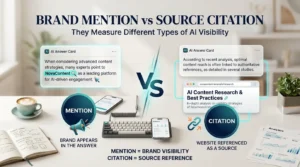
A brand mention and a citation are not the same result.
A brand mention occurs when Perplexity names a company, product, person, or publication in the generated answer. The answer may describe the brand accurately or inaccurately yet provide no link to its website.
A citation points to a source URL used or displayed in connection with the answer. That URL could belong to your website, a competitor, a review publisher, a news site, a forum, documentation, or another third party.
For example, Perplexity might recommend “Example Software” but cite an independent review rather than Example Software’s product page. The brand wins a mention, while the third-party publisher wins the citation.
- Text-only brand appearances
- Links to brand-owned pages
- All cited third-party sources
- The precise URLs receiving citations
- Mentions and citations as separate rates
This distinction also matters when reviewing AI-generated claims. Trace and fact-check AI-generated content against the cited source and official documentation. How to Fact-Check AI-Generated Content
Perplexity Rank Tracking vs Google Rank Tracking
| Traditional Google Rank Tracking | Perplexity Visibility Tracking |
| Numerical SERP positions | Presence within generated answers |
| Keyword → ranking URL | Prompt → mention or citation |
| Relatively structured results | Synthesized, variable response |
| Position history | Mention, citation, or answer history |
| Often positions 1–100 | Inclusion, placement, or absence |
| Desktop, mobile, local SERPs | Engine, model, country, or prompt settings |
| Competing ranking URLs | Competing brands and cited sources |
| One URL at each position | Several cited pages in one answer |
| Position is central | Citation, mention, and SOV may matter more |
Neither measurement replaces the other. Teams can combine these insights with a careful ChatGPT SEO optimization workflow, while retaining source verification and editorial review. ChatGPT SEO Optimization
For the Google search side of this comparison, our visibility score guide explains how keyword-based SEO visibility differs from traffic. Keep that score separate from Perplexity citation and mention rates; each measures a different kind of visibility.
Best Perplexity Rank Tracker Metrics That Actually Matter
The Best Perplexity Rank Tracker should measure meaningful visibility signals instead of reducing every Perplexity response to one numerical position.
Citation Rate
How often a domain or page receives a citation across tracked runs. Check the vendor’s denominator, engines, and frequency.
Mention Rate
How frequently an answer names the monitored brand, even when no brand-owned URL appears.
A vendor-defined estimate of measured visibility relative to selected competitors. Use trends within one platform rather than comparing raw scores across vendors.
Cited URLs
The exact product pages, guides, reviews, or competitor resources used as sources.
Prompt Visibility
Whether a brand or domain appears for each question. Topic and intent groups reveal where visibility is concentrated.
Competitor Visibility
Which brands appear when yours does not, plus the pages associated with that gap.
Historical Trend
Repeated tracking that separates one-off output from a persistent pattern. A change does not prove causation.
Geographic Visibility
Location-related differences where both the engine and tracker support the required market and language.
Best Free Perplexity Rank Tracker Options
There is no clearly verified permanent free product in this comparison that provides unlimited, ongoing Perplexity prompt tracking.
- Free one-time checker — Ahrefs provides a free AI visibility snapshot. It does not replace Brand Radar’s historical monitoring or scheduled prompts.
- Limited daily checks — SE Ranking advertises up to five free AI visibility checks per day through its public checker. Recurring prompt tracking belongs to the paid toolkit.
- Free trials — OtterlyAI, Peec AI, Keyword.com, Rankability, and SE Ranking advertise trials or trial access. A time-limited trial is not a permanent free plan.
Manual checking costs nothing but has methodological limitations. Results can change between sessions, locations, models, and runs. For a small prompt set, record the date, exact prompt, answer, mention, cited URLs, and settings consistently.
How to Choose the Best Perplexity Rank Tracker
- For a blogger or small website — Start with OtterlyAI if 15 carefully selected prompts are enough. Consider manual tracking while the content library remains small.
- For combined Google and Perplexity reporting — Keyword.com provides an economical entry point, while SE Ranking supplies a broader agency toolkit.
- For dedicated daily AI analytics — Peec AI balances competitors, citations, sentiment, and team access.
- For content agencies — Compare Rankability’s connected content workflow with SE Ranking’s reporting and SEO suite.
- For existing Semrush customers — The AI Visibility Toolkit may reduce vendor count, although its per-domain structure deserves attention.
- For large-scale prompt research — Ahrefs Brand Radar provides broad indexes plus custom monitoring.
- For enterprise governance — Request a scoped demonstration and written proposal from Profound.
Before subscribing, calculate: number of prompts × number of engines × number of locations × check frequency × number of projects. This reveals whether the advertised starting price reflects your actual use case.
Does Advanced Web Ranking Integrate With Perplexity?
Yes. Advanced Web Ranking (AWR) supports Perplexity as a trackable AI search engine. It reports which source URLs appear for selected keywords, their positions and visibility, and competitor performance. AWR also provides Perplexity result snapshots and lets users compare Perplexity visibility with traditional search engines.
This makes AWR useful when your goal is keyword-level source tracking rather than only counting brand mentions. Availability varies by target country, so confirm that Perplexity tracking is supported for the market you need before subscribing.
- Best for: comparing keyword and URL visibility across Perplexity and traditional search.
- Tracks: source URLs, positions, visibility, competitors, and changes between updates.
- Important limitation: Perplexity answers can vary, so repeated trends matter more than one isolated result.
Official source: Advanced Web Ranking’s Perplexity tracking guide.
When You Probably Don’t Need a Paid Perplexity Tracker
- Your website is new and has only a few substantive pages.
- You have not defined target topics, audiences, or commercial prompts.
- Your content library is too small for meaningful competitive analysis.
- You only need to check a handful of prompts occasionally.
- Your budget would produce more value through original research, expert editing, technical SEO, or better core content.
- Nobody has time to review the data and act on legitimate content gaps.
Tracking does not create visibility by itself. It measures selected outputs under selected conditions. If the website lacks accurate, distinctive, accessible content, a sophisticated dashboard mainly provides a more detailed view of that weakness.
Therefore, even the Best Perplexity Rank Tracker may not provide enough value until your website has a clear content and AI-search strategy.
How to Use a Perplexity Visibility Tracker
Step 1: Define Important Prompts
Select questions reflecting discovery, comparison, and buying situations. Include branded, non-branded, problem-led, and comparison prompts.
Step 2: Add Your Brand and Competitors
Enter name variations, product names, domains, and genuine competitors.
Step 3: Establish a Baseline
Record mentions, citations, cited pages, competitors, and exact monitoring settings before drawing conclusions.
Step 4: Track Citations and Mentions
Review the metrics separately. Determine whether Perplexity names the brand, links to its website, cites a third party, or does none of these.
Step 5: Identify Frequently Cited Competitor Pages
Compare recurring cited pages by scope, evidence, clarity, freshness, source quality, and relevance.
Step 6: Improve Your Own Content
Correct factual gaps and add first-party evidence, clear definitions, expert input, transparent comparisons, dates, and source links where appropriate.
Step 7: Monitor Changes Over Time
Review repeated runs rather than celebrating one appearance. Content changes do not guarantee future citations.
Related AI Search Guides
- AI Search Engine Optimization Services: Complete Guide
- How to Boost Visibility in AI Search
- How to Check Brand Mentions in ChatGPT
- How to Track Brand Mentions in Gemini
Before selecting a paid platform, try the repeatable manual workflow in our guide to tracking your brand in Perplexity AI. It helps you define prompts, record citations, and decide which monitoring features you actually need.
Conclusion
The Best Perplexity Rank Tracker depends on the questions you need the data to answer. Peec AI provides the strongest overall specialist package, while OtterlyAI offers a more accessible option for bloggers and small businesses. Keyword.com is the budget-conscious choice for combining Google and AI visibility, and SE Ranking suits agencies that need broader SEO reporting. Ahrefs Brand Radar and Profound serve larger research and enterprise programs.
Before buying, confirm whether the platform tracks citations, brand mentions, or both. Then calculate your required prompts, engines, locations, projects, and checking frequency. Most importantly, do not treat Perplexity visibility as a stable Google-style position. The right tool should reveal patterns across repeated answers—not reduce a variable answer engine to one misleading rank number.