
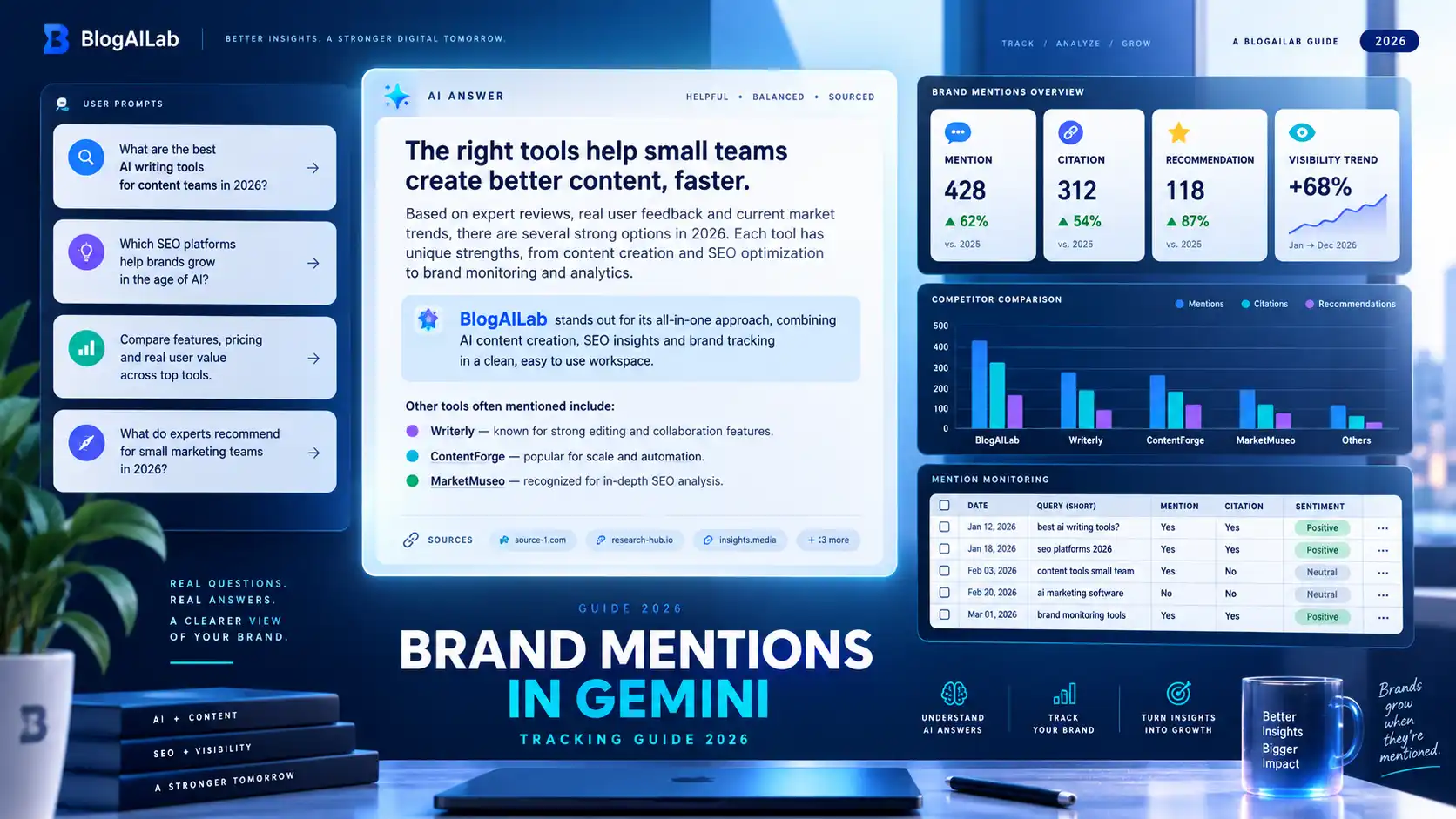

Tracking brand mentions in Gemini is less straightforward than checking a Google keyword ranking. Gemini can name your brand, recommend it, cite your website, link to a page, or do none of these things in a particular response. Those signals should not be treated as interchangeable.
For most bloggers and small businesses, the best starting point is not an expensive monitoring platform. Instead, create a controlled set of relevant prompts, run them consistently, record mentions and citations separately, and compare the results over time.
This guide shows you how to build that workflow for free. You will also learn what to measure, how to avoid misleading conclusions, and when automated Gemini visibility tracking becomes useful.
What Are Brand Mentions in Gemini?
A brand mention occurs when Gemini names or discusses a company, website, publication, product, or other identifiable brand in its generated answer.
A mention does not automatically mean Gemini used the brand’s website as a source. For example, an answer could name five blogging platforms without linking to their websites. Each named company received a brand mention, but none necessarily received a citation.
That distinction matters because Gemini Apps do not provide sources for every response. Google states that sources or related links may appear when available, but some responses have no Sources option.
Brand Mention vs Citation vs Recommendation
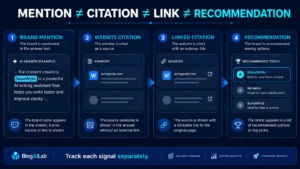
These signals answer different measurement questions.
| Signal | What it means | Link required? | What to record |
| Brand mention | Gemini names or discusses the brand | No | Brand name, context, prompt |
| Website citation | The site/page appears as a supporting source | Not necessarily | Domain, URL, source context |
| Linked citation | A clickable link points to the website | Yes | Exact destination URL |
| Recommendation | Gemini presents the brand as an option or choice | No | Recommendation context and approximate placement |
| Visibility | Frequency/prominence across a defined prompt set | No | Mention rate, position/context, prompt coverage |
| Traditional Google ranking | A webpage’s placement in conventional Search results | Search-result dependent | Query, ranking page and position |
Therefore, “Gemini mentioned us” and “Gemini cited us” should never occupy the same spreadsheet column. Similarly, traditional rank tracking follows a query → result → webpage-position model, while Gemini monitoring more often follows a prompt → generated response → mention/citation/recommendation model.
Why Track Brand Mentions in Gemini?
The first purpose is visibility monitoring. A consistent prompt set can show whether your brand appears when people ask questions connected to your products, expertise, or category.
Second, monitoring can reveal reputation and accuracy problems. Because Google warns that Gemini Apps can generate inaccurate information, periodically reviewing how your brand is described can uncover incorrect product details, outdated facts, or misleading comparisons.
Competitor comparison is another useful application. If several competitors appear frequently across non-branded discovery prompts while your brand rarely appears, you have identified a visibility gap worth investigating.
You can also discover citation opportunities. Recording frequently cited third-party websites may reveal which publishers, directories, studies, or resources repeatedly support answers in your niche.
Finally, prompt-level monitoring can expose content gaps. If important audience questions rarely connect to your brand or content, examine whether your site actually provides a strong answer. A mention alone does not prove that somebody visited your website, bought a product, or converted.
What You Need Before You Start Tracking
Prepare a small tracking specification before opening Gemini. Record your official brand name, common spelling variations, website domain, and a manageable competitor list. Then define the topics for which you actually want discovery visibility.
For example, a blogging software company might use categories such as AI writing, keyword research, blog optimization, content planning, and AI-search measurement.
- Target audience
- Target country or market
- Core competitors
- Prompt categories
- Exact prompts
- Gemini surface or model used
- Tracking frequency
- Spreadsheet location
This preparation prevents an easy mistake: running random questions until you find one answer that mentions your brand.
How to Track Brand Mentions in Gemini Manually
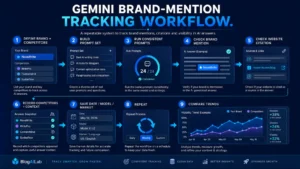
- Define your brand and competitors. Start with one canonical brand name plus genuine spelling variations. Choose three to five competitors relevant to the same audience and category.
- Build prompt categories. Use multiple intents: discovery, comparisons, recommendations, problems, alternatives, and informational research.
- Write non-branded discovery prompts. Branded prompts test Gemini’s response to an already specified entity. Non-branded prompts are more useful for testing discovery visibility.
- Run prompts consistently. Use the same wording, market, and preferably the same Gemini surface/model for recurring checks.
- Record mentions and citations separately. For each answer, record whether the brand appeared in the text. Then inspect sources or related links when available and record website citations and clickable links separately.
- Save the date and context. Record date, prompt, market, Gemini surface/model, mention, citation, linked citation, competitors, context, and notes.
- Repeat the same prompt set. Weekly or monthly repetition generally provides more useful trend information than checking random prompts every day.
- Compare changes cautiously. Gemini results can change even when your website did not. Treat changes as observations that need repetition, not proof of a fixed ranking change.
Gemini Prompt Examples for Brand Tracking
Discovery
- What are useful [product category] tools for [audience]?
- Which companies specialize in [industry] for [audience]?
- What resources should someone use to learn about [topic]?
Comparison
- Compare popular [product category] options for [audience].
- Which [industry] brands are strongest for [specific use case]?
- Compare [brand] with alternatives for [audience].
Recommendation
- Recommend [product category] options for someone who needs [requirement].
- What [industry] services would you consider for [problem] in [country]?
- Which tools can help [audience] solve [problem]?
Problem-solving
- I am struggling with [problem]. What tools or resources could help?
- How should a [audience] solve [specific problem], and which products may help?
Product or service alternatives
- What are alternatives to [brand] for [use case]?
- What options are similar to [product/service] but better suited to [audience]?
Informational research
- What are reliable sources for learning about [topic]?
- Which websites publish useful information about [industry]?
Non-branded discovery prompts provide the strongest discovery test because your brand is not supplied in advance.
Free Gemini Brand-Mention Tracking Spreadsheet
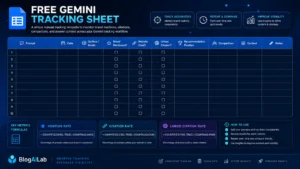
A simple spreadsheet is enough for your first tracking system.
| Prompt | Date | Surface/model | Brand? | Site cited? | Linked? | Position | Competitors | Context | Notes |
| [Prompt 1] | [Date] | [Complete] | [Y/N] | [Y/N] | [Y/N] | [Complete] | [Complete] | [Complete] | [Complete] |
| [Prompt 2] | [Date] | [Complete] | [Y/N] | [Y/N] | [Y/N] | [Complete] | [Complete] | [Complete] | [Complete] |
Mention Rate: (Responses mentioning your brand ÷ Total prompts checked) × 100
Citation Rate: (Responses citing your website ÷ Total prompts checked) × 100
Linked Citation Rate: (Responses containing a clickable citation to your site ÷ Total prompts checked) × 100
These are publisher-created measurement methods, not official Google ranking metrics. Keep the denominator stable when comparing periods.
Important Metrics to Monitor
Mention rate: Shows how frequently the brand appears across the controlled prompt set. It does not by itself show accuracy, prominence, or links.
Citation rate: Measures how often the website appears as a source. Citation interfaces can change, and not every response includes sources.
Linked citation rate: Isolates responses where a user can follow a citation to the site. It still does not show whether anyone clicked.
Recommendation frequency: Records how often Gemini actively suggests the brand. Approximate placement should not be treated like a fixed Google ranking.
Competitor mention rate: Adds context, but comparisons are valid only when competitors are measured against the same prompts.
Citation sources: Reveals websites that repeatedly support answers. Do not assume those sources are confirmed Gemini ranking factors.
Context or sentiment: Can identify positive, neutral, inaccurate, or negative descriptions. Automated sentiment should be manually reviewed.
Prompt coverage: Measures the proportion of strategically important audience questions represented in the test set.
Changes over time: Usually the most useful metric. Stable methodology matters more than a single visibility score.
Tools That Can Help Track Gemini Mentions
The tools below are included because their provider documentation referenced Gemini monitoring at the time of verification. This is not a universal ranking, and provider-documented features should not be interpreted as independently validated accuracy claims.
| Tool | Gemini support | Tracks | Free/trial | Entry pricing* | Best for | Important limitation |
| OtterlyAI | Yes, paid add-on | Prompts, brand visibility, citations, domains, trends | Temporary trial | Lite $29/mo + Gemini $9/mo | Bloggers/small teams | Gemini is not included in Lite base price |
| Peec AI | Yes, selectable model | Mentions, citations, position, sentiment, competitors, trends | Trial offered | $95/mo Starter | SEO/GEO teams | Starter includes 3 selected models |
| Scrunch | Yes | Prompts, presence, citations, trends, page opportunities | 7-day Starter trial | $300 monthly or $250/mo annual | Larger teams/agencies | Higher entry cost |
*Pricing and features verified August 23, 2026. Taxes, currencies, billing terms, trials, add-ons, and product coverage may change. Verify the provider’s current plan before purchasing.
OtterlyAI’s current documentation lists Gemini as an add-on. Peec AI documents Gemini among selectable models. Scrunch lists Gemini among supported platforms. If your priority is Perplexity as well, BlogAILab separately compares tools for monitoring Perplexity visibility.
Manual Tracking vs Automated Tracking
| Factor | Manual tracking | Automated tracking |
| Cost | Usually free apart from your time | Subscription/add-on costs |
| Setup time | Spreadsheet + prompt set | Account/project configuration |
| Prompt capacity | Low | Much higher |
| Historical data | You maintain it | Usually stored by platform |
| Consistency | Depends on researcher discipline | Scheduled execution helps |
| Competitor tracking | Manual recording | Often automated |
| Best use case | Initial validation, small sites | Recurring larger-scale monitoring |
| Limitations | Slow and labor-intensive | Vendor methodology and platform costs |
For an individual blogger, start manually with 10–20 high-value prompts.
A small business can use manual monitoring first and move to automation when multiple products, locations, or competitors make spreadsheets cumbersome.
An agency will usually benefit earlier from automation because client reporting, repeated prompts, markets, and competitors multiply quickly.
A larger brand should evaluate exports, API access, geographic controls, governance, raw-response access, and the vendor’s measurement methodology rather than choosing solely by a headline visibility score.
How Often Should You Check Gemini Mentions?
For a small stable prompt set, checking monthly can be enough to establish a baseline.
During an active product launch or major content campaign, weekly checks may provide more useful observations. Competitive categories can also justify weekly measurement, provided the prompts remain unchanged.
For an established monitoring program, automated daily data may be useful for calculating weekly or monthly trends. However, the presence of daily data does not mean every daily fluctuation deserves action.
Avoid running random prompts every day and describing short-term variation as a trend.
How to Improve Your Chances of Being Mentioned in Gemini
There is no documented checklist that guarantees a Gemini mention. A stronger approach is to improve the quality and discoverability of the information associated with your brand:
- Publish clear, useful, original content.
- Develop identifiable expertise around a focused topic.
- Keep facts, prices, dates, and product details current.
- Use descriptive titles and headings.
- Answer real audience questions directly.
- Earn legitimate coverage or mentions from relevant third-party sources.
- Maintain consistent brand and entity information.
- Strengthen contextual internal links.
- Keep important pages accessible and indexable.
- Add original research, tests, examples, comparisons, or data when you genuinely have them.
Google’s guidance for generative features in Search reinforces the continuing value of foundational SEO and useful, original, people-first content. That guidance concerns Google Search’s generative features rather than a published Gemini-app ranking formula, so avoid turning it into unsupported claims about how Gemini chooses every brand mention.
Generative engine optimization (GEO) should complement traditional SEO rather than replace it.
Common Gemini Tracking Mistakes
The most common error is using only branded prompts. If you supply the brand in every question, you are largely measuring how Gemini responds to an already-known entity rather than whether it discovers the brand independently.
- Changing prompts during every tracking cycle
- Combining mentions and citations
- Treating one answer as a trend
- Ignoring country, model, account, and personalization differences
- Depending on one proprietary visibility score
- Recording results without dates
- Assuming every mention produces traffic
- Publishing fictional first-hand testing
- Copying outdated software pricing
- Comparing competitors using different prompt sets
Consistency will not eliminate generative variation, but it makes your observations far more interpretable.
Your Gemini Monitoring Checklist
- Keep a fixed list of relevant prompts and use the same wording each time.
- Record the date, market, Gemini surface or model, and any personalization settings.
- Save the response and check brand mentions, citations, and recommendations separately.
- Review inaccurate brand descriptions and open the cited source pages.
- Compare repeated observations before interpreting a change as a trend.
Frequently Asked Questions
Can I see brand mentions in Gemini through Google Search Console?
Not directly for the standalone Gemini app based on Google’s current documentation. Search Console’s generative-AI performance reporting should be interpreted according to its documented Search surfaces, not as a direct Gemini-app mention report.
Does a Gemini brand mention always include a link?
No. Gemini may mention a brand without linking to its website, and not every Gemini Apps response contains sources or related links.
Is Gemini brand tracking the same as traditional rank tracking?
No. Traditional tracking follows webpage positions for search queries. Gemini monitoring measures generated responses, including mentions, citations, recommendations, competitors, and changes across prompts.
Can I track Gemini mentions for free?
Yes, manually. Create a defined prompt set and record the answers in a spreadsheet. Dedicated monitoring software can automate the process, but trial access should not be confused with a permanent free plan.
How often should I repeat the same prompts?
Monthly is reasonable for a small baseline program; weekly can suit active campaigns or competitive niches. More frequent monitoring only helps when methodology remains consistent.
Why do Gemini’s answers change?
Generative responses can vary with wording, context, product changes, location, personalization, account settings, model/surface, and time.
Can tracking guarantee better Gemini visibility?
No. Measurement identifies patterns and gaps; it cannot force Gemini to mention, recommend, or cite a brand.
Final Thoughts
The practical way to track brand mentions in Gemini is to begin with a controlled experiment rather than chase a single “rank.”
Define the prompts that matter to your audience, emphasize non-branded discovery queries, record mentions and citations independently, note your market and Gemini surface, and repeat the same tests on a sensible schedule. Once the volume becomes difficult to manage manually, compare automated tools based on prompt capacity, Gemini coverage, raw evidence, competitor analysis, methodology, and total cost.
Most importantly, use the findings to improve real content and brand information rather than trying to manufacture mentions.
Next, read BlogAILab’s practical guide to improving AI search visibility to connect measurement with a broader SEO and GEO workflow.
Related AI Search Guides
- How to Improve AI Search Visibility — connect monitoring with a practical content-improvement plan.
- How to Write Better AI Prompts — create clear, repeatable tracking questions.
- Best Perplexity Rank Tracker Tools — compare tools if you also monitor Perplexity.
- ChatGPT SEO Optimization Guide — improve the content your audience needs.
- Claude vs ChatGPT vs Gemini for Bloggers — understand the assistants’ different workflows.
- How to Humanize AI Content — edit drafts with accuracy and reader usefulness in mind.
To compare another answer engine, follow our guide to tracking brand mentions in Perplexity AI. Record each engine separately and compare repeated observations rather than treating one answer as a fixed ranking.
Official Sources
The guidance above draws on these Google help pages. Product behavior and documentation can change; check the current source when planning your monitoring workflow.