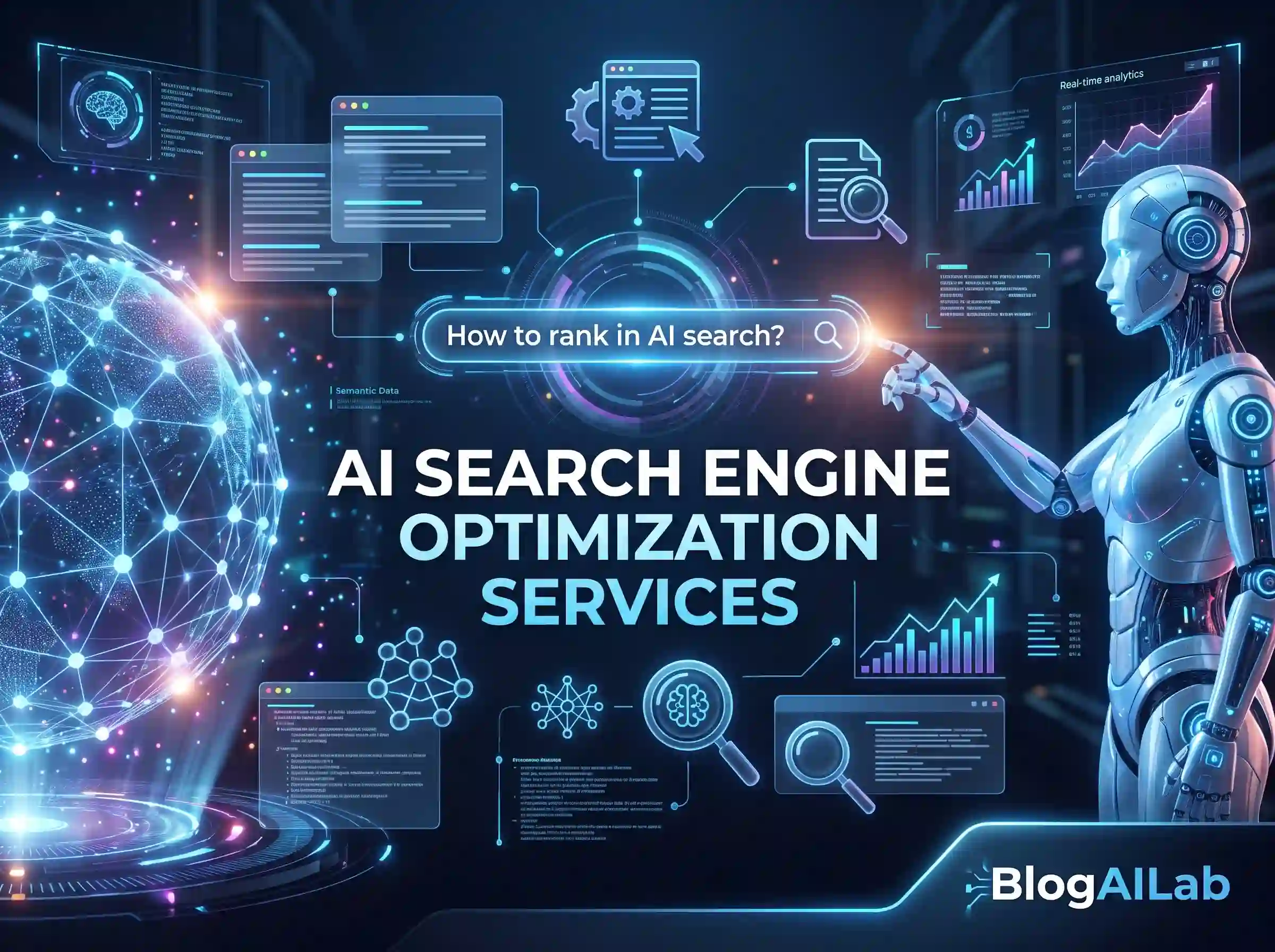

Search behavior is shifting. While people still type queries into search bars, securing professional ai search engine optimization services has become crucial as users turn directly to AI tools like ChatGPT, Perplexity, and Google’s AI Overviews for synthesized answers. Ranking on page one is no longer the only thing worth optimizing for. Now brands also need to think about whether they’re mentioned or cited when an AI system pulls together an answer.
What Are AI Search Engine Optimization Services?
AI search engine optimization services are a set of strategies and technical practices designed to help a website’s content be found, understood, and referenced by AI-powered search and answer systems — in addition to ranking in traditional search results.
In practice, this usually blends three overlapping disciplines:
- Traditional SEO — the established practice of optimizing for search engine rankings through keywords, technical performance, backlinks, and content quality.
- AI SEO — an umbrella term for adapting SEO practices to account for how AI systems process and summarize content, including AI Overviews and chatbot-style search.
- Generative Engine Optimization (GEO) — a more specific focus on improving how content is selected, quoted, or cited by generative AI tools when they compose an answer.
These terms are often used loosely and interchangeably in the industry, and there’s no single standardized definition all providers agree on. What matters more than the label is the underlying goal: making content easy for both people and machines to find, trust, and use accurately.
It’s worth being upfront about something many articles gloss over: no reputable provider can guarantee a specific citation in ChatGPT or a specific placement in an AI Overview. AI systems make selection decisions dynamically, and those processes aren’t fully public. What AI search optimization *can* do is improve the underlying signals — content quality, structure, entity clarity, authority — that make a brand more likely to be surfaced over time.
Why You Need AI Search Engine Optimization Services
The practical case for AI search optimization isn’t hype — it’s about not losing ground as discovery habits change.
- Brand discovery. If potential customers are researching a category by asking an AI assistant instead of scrolling search results, a business that isn’t well-represented in structured, quotable content may simply not come up.
- Search visibility beyond rankings. Visibility now spans traditional rankings, featured snippets, AI Overviews, and chatbot references — a broader surface area than SEO covered a few years ago.
- Qualified traffic. When someone does click through from an AI-generated answer, they’ve often already been pre-qualified by the context of that answer, which can mean higher-intent visits.
- Authority and trust signals. The same things that help AI systems trust content — clear expertise, accurate information, credible sourcing — also build long-term brand authority with human readers.
- Content discoverability. Well-structured, clearly organized content is easier for both search crawlers and AI summarization systems to parse correctly.
None of this comes with guarantees. AI search optimization is about improving the odds and building durable foundations, not manufacturing a shortcut to guaranteed citations or traffic.
Traditional SEO vs AI Search Optimization
The two approaches share a foundation but differ in emphasis. Here’s a practical comparison:
| Factor | Traditional SEO | AI Search Optimization |
| Primary objective | Rank in search engine results pages | Be found, understood, and referenced across search and AI answer experiences |
| Search experience | List of ranked links | Synthesized answers, summaries, conversational responses |
| Content requirements | Keyword-relevant, well-structured pages | Clear, well-structured, directly answerable, fact-accurate content |
| Keywords | Central to strategy | Still relevant, but intent and entities matter more than exact-match phrasing |
| Entities | Secondary consideration | Central — brands, people, products, and concepts need to be clearly defined |
| Structured data | Helpful for rich results | Helpful for machine understanding of page content and entities |
| Authority | Backlinks and domain authority | Backlinks plus mentions, citations, and consistent expertise signals across the web |
| Citations/mentions | Not typically tracked | A meaningful (if hard-to-measure) visibility signal |
| User intent | Keyword-based intent matching | Deeper intent and context matching across a query or conversation |
| Measurement | Rankings, organic traffic, CTR | Rankings and traffic, plus brand mentions, referral traffic, and observable citations where tools allow |
The two aren’t competing strategies — AI search optimization extends traditional SEO rather than replacing it.
How AI-Powered Search Changes SEO
Modern AI-powered search experiences don’t just match keywords to pages. Many are designed to pull information from multiple sources and synthesize it into a single response.
That process tends to reward a different mix of signals than classic ranking factors alone:
- Search intent and context — content needs to answer the actual question, not just include the right keyword.
- Entities — clear, consistent identification of who a business is, what it does, and how it relates to other known entities (people, products, industries) helps machines connect the dots.
- Topical authority — depth across a subject area tends to matter more than a single well-optimized page.
- Trust and source credibility — content that’s accurate, well-sourced, and consistent with other credible information is more useful to summarize.
- Content quality — clear writing, accurate claims, and genuine usefulness remain foundational.
- Structured information — schema markup and clean HTML structure help machines parse what a page is actually saying.
- Brand mentions — being referenced by other credible sites, even without a link, appears to contribute to how AI systems perceive a brand’s relevance.
It’s important to be precise here: there is no single, universal ranking algorithm shared by Google, Bing, ChatGPT, Perplexity, Gemini, and other AI search tools. Each platform has its own retrieval and summarization approach, and these systems change frequently. Anyone claiming to have fully reverse-engineered “the AI search algorithm” should be treated with skepticism.
What Does an AI Search Engine Optimization Service Include?
A professional AI search optimization engagement typically combines several workstreams. Here’s what each one actually involves.
AI Search Visibility Audit
An assessment of how a brand currently appears — or fails to appear — across traditional search, AI Overviews, and AI chat tools for relevant queries. This usually includes manually checking how the brand shows up (or doesn’t) in a sample of representative AI search sessions.
Technical SEO Analysis
A review of crawlability, indexability, site speed, mobile usability, and core web vitals. AI systems and traditional crawlers both need clean, accessible technical infrastructure to read a site properly.
Keyword and Search Intent Research
Identifying not just keywords, but the underlying questions, comparisons, and decisions a target audience is working through — since AI search tends to respond to full questions rather than fragments.
Entity and Brand Optimization
Making sure a business, its products, and its key people are clearly and consistently described across the website and third-party sources, so AI systems can confidently identify who the brand is and what it’s known for.
Topical Authority Development
Building out comprehensive coverage of a subject area — not just isolated pages — so a site becomes a credible, complete resource on its core topics.
Content Optimization
Improving existing content for clarity, accuracy, direct answers, and structure, without simply stuffing in keywords.
Content Gap Analysis
Identifying questions, subtopics, and comparisons a business hasn’t covered yet, but that its audience is clearly asking about.
Structured Data and Technical Optimization
Implementing schema markup (Organization, Article, FAQ, Product, and similar types where relevant) to help search and AI systems understand page content and entities more precisely.
Internal Linking Optimization
Connecting related content in a logical structure so both users and machines can navigate topic clusters and understand how pages relate to each other.
Digital PR, Brand Mentions and Authority Signals
Earning credible references, mentions, and links from relevant third-party sites — a long-standing SEO practice that also appears to support AI-era authority signals.
AI Search Visibility Monitoring
Ongoing tracking of brand mentions, citation patterns where observable, rankings, and traffic to understand whether visibility is improving over time.
How to Optimize a Website for AI Search
For businesses handling this in-house, or evaluating a provider’s approach, here’s a practical checklist:
- Create genuinely useful content that solves a real problem, rather than content built purely around a keyword.
- Answer specific user questions directly and early in the content, rather than burying answers under long introductions.
- Build topical depth by covering a subject thoroughly across multiple connected pages, not just one.
- Strengthen entity clarity — make sure it’s obvious who your brand is, what it offers, and how it’s positioned in its industry.
- Improve internal linking so related content is easy to discover and topic relationships are clear.
- Use appropriate structured data to help machines parse page content accurately.
- Maintain accurate business information across your site, directories, and third-party profiles.
- Demonstrate expertise and trust through author credentials, sourcing, and transparent, accurate claims.
- Earn credible mentions and references through digital PR, partnerships, and genuine industry engagement.
- Keep important information easy to find and retrieve — clear headings, concise answers, and logical page structure all help.
AI SEO Content Strategy
A strong AI search content strategy is usually built around topic clusters rather than one-off articles. A simple model looks like this:
Pillar Topic** → **Supporting Articles** → **Question-Based Content** → **Comparison Content** → **Commercial Content** → **Internal Links** → **Strong Topical Authority
For example, a business offering project management software might structure a cluster like this:
- Pillar page: “Project Management Software: The Complete Guide”
- Supporting articles: Agile vs. waterfall project management, remote team collaboration, resource planning basics
- Question-based content: “What is a Gantt chart used for?” or “How do you track project milestones?”
- Comparison content: “[Tool] vs. [Competitor]” or “Best project management software for small teams”
- Commercial content: Pricing pages, feature pages, use-case pages for specific industries
- Internal links: Every supporting piece links back to the pillar and to related supporting content
This structure gives both search engines and AI systems a clear, well-connected map of everything the site knows about the topic — which is a large part of what topical authority actually means in practice.
AI Search Optimization for Different Types of Businesses
- SaaS companies benefit from strong comparison content, feature-specific pages, and clear entity definitions for product names and use cases.
- E-commerce websites should prioritize product schema, accurate specifications, and content that answers pre-purchase questions, not just product listings.
- Agencies need case-study-style expertise content (without fabricated results) and clear service-area pages.
- Local businesses should focus on accurate, consistent business information (NAP data, hours, service areas) across their site and directories, plus local schema markup.
- Bloggers and publishers benefit most from topical depth, clear author expertise signals, and internal linking between related posts.
- B2B companies should prioritize question-based and comparison content that mirrors how buying committees actually research decisions.
- Startups get the most value from building a small number of genuinely authoritative pillar pages before expanding broadly, rather than publishing thin content at volume.
How to Measure AI Search Visibility
Measuring AI search visibility is genuinely harder than tracking traditional rankings — and it’s worth saying plainly that no single metric captures it fully yet.
Useful signals to track include:
- Brand mentions across the web, including unlinked mentions
- AI citations or references, where a given platform makes this observable (this varies significantly by tool and isn’t consistently trackable across all AI systems)
- Organic traffic trends over time
- Branded search growth (more people searching for your brand name directly)
- Referral traffic from AI tools where trackable in analytics
- Traditional rankings for relevant queries
- Search impressions in tools like Google Search Console
- Content performance — engagement, time on page, scroll depth
- Conversion performance from organic and AI-referred traffic
There’s no legitimate universal “AI SEO score” that objectively measures visibility across every AI platform — be cautious of any tool or provider claiming to offer one as a definitive metric. The most reliable approach combines several of these signals over time rather than relying on a single number.
How Much Do AI Search Engine Optimization Services Cost?
Pricing varies too widely to state a single reliable figure, and any article claiming an exact “industry standard” rate should be read with caution. What actually drives cost includes:
- Website size — a 20-page site and a 2,000-page site require very different levels of effort
- Industry competitiveness — some niches require significantly more content and authority-building work
- Number of pages requiring optimization
- Technical complexity — platform limitations, site migrations, or legacy code can add work
- Content requirements — how much new content needs to be created versus optimized
- Authority-building requirements — the scope of digital PR or mention-earning work involved
- Reporting and monitoring — the depth of ongoing measurement and analysis
- Ongoing optimization — SEO and AI search optimization are rarely one-time projects; most engagements involve continuous work
When evaluating quotes, it’s more useful to ask what’s included and how progress will be measured than to compare a single dollar figure across providers.
How to Choose an AI SEO Service Provider
A practical checklist for evaluating providers:
- Proven SEO expertise — not just AI-specific buzzwords, but a solid grasp of technical and content fundamentals
- Clear methodology — they can explain what they’ll actually do, in plain language
- Transparent reporting — you can see what’s being measured and why
- Technical SEO knowledge — crawlability, site structure, and performance still matter
- Content expertise — the ability to produce genuinely useful, accurate content
- Understanding of AI search — familiarity with how AI Overviews, chat-based search, and citation behavior work, without overstating certainty
- No guaranteed ranking or citation claims — this is one of the clearest red flags in the industry right now
- Clear KPIs — specific, agreed-upon metrics rather than vague promises of “visibility”
- Sustainable strategy — a plan built for the long term, not quick tricks likely to be devalued as platforms evolve
Be especially cautious of any provider promising guaranteed placement in ChatGPT responses, guaranteed AI Overview inclusion, or “instant” AI rankings. No one controls these outcomes directly, and claims like this are a strong signal to look elsewhere.
AI SEO vs GEO vs Traditional SEO
These three terms overlap more than they conflict, and the industry hasn’t fully standardized the distinctions:
- Traditional SEO is the foundational discipline — optimizing for search engine crawlers and rankings through technical health, content quality, and authority.
- AI SEO is generally used as a broader term for adapting SEO practices to account for AI-influenced search experiences, including AI Overviews and chat-based search.
- GEO (Generative Engine Optimization) is typically used more specifically for optimizing how content is selected and cited by generative AI tools when composing an answer.
In practice, all three rely on the same underlying fundamentals: clear content, technical accessibility, credible authority, and genuine usefulness to the reader. Businesses don’t need to pick one and abandon the others — a solid strategy treats them as layers of the same broader goal, not separate competing approaches.
Frequently Asked Questions
What are AI Search Engine Optimization Services?
They’re a combination of SEO strategies and technical practices aimed at helping a website’s content be found, understood, and referenced across both traditional search engines and AI-powered search and answer tools.
Is AI SEO different from traditional SEO?
It builds on traditional SEO rather than replacing it, with added emphasis on entities, topical authority, structured data, and how content gets summarized by AI systems.
What is GEO?
Generative Engine Optimization refers to optimizing content specifically for how generative AI tools select and cite information when generating answers.
Can SEO help a website appear in AI search?
Yes — strong technical SEO, content quality, and authority signals contribute to visibility in AI-powered search, though no provider can guarantee specific citations or placements.
How do businesses measure AI search visibility?
Through a combination of brand mentions, observable citations where platforms allow tracking, organic traffic, branded search growth, referral traffic, and traditional ranking data — there’s no single definitive metric yet.
Do AI SEO services replace traditional SEO?
No. AI search optimization extends traditional SEO practices; both continue to matter, since traditional search results remain a major discovery channel.
How long does AI search optimization take?
Timelines vary by site size, competitiveness, and starting point, but meaningful, durable improvements in search and AI visibility typically build over months rather than days.
How much do AI SEO services cost?
Cost depends on factors like site size, industry competitiveness, content needs, and the scope of ongoing work — there’s no universal fixed price across the industry.
Related AI Search and Visibility Guides
- Best Perplexity Rank Tracker Tools
- How to Check Brand Mentions in ChatGPT
- How to Track Brand Mentions in Gemini
- How to Boost Visibility in AI Search
- ChatGPT SEO Optimization for Bloggers
Conclusion
Search is no longer just about ranking links — it’s about being understood, trusted, and referenced by systems that summarize information on a user’s behalf. That doesn’t make traditional SEO obsolete; it makes it the foundation for something broader.
AI search engine optimization services bring together technical SEO, content strategy, entity clarity, and authority-building to help a brand stay visible as discovery habits keep evolving. There are no shortcuts and no guarantees — but there is a clear, practical path: build genuinely useful content, structure it well, and make your expertise easy for both people and machines to recognize.
If you’re not sure where your brand currently stands, a good first step is simply reviewing how your business shows up — or doesn’t — across a handful of relevant AI search sessions and traditional queries. That gap is usually the clearest starting point for a real strategy.