
If you are trying to learn how to check brand mentions in ChatGPT, you do not need to start with an expensive monitoring platform. You can build a useful baseline with carefully selected prompts, a spreadsheet, and regular checks.
The question matters because people now use AI assistants to research products, compare tools, evaluate services, and request recommendations. However, seeing your brand in one response does not prove stable visibility. ChatGPT generates each answer from the prompt, available context, product experience, and information accessible at that moment.
Therefore, you need to track patterns rather than celebrate or panic over a single answer. This guide explains how to test relevant prompts, separate brand mentions from citations, compare competitors, record changes, and decide when an automated AI visibility tool makes sense.
What Are ChatGPT Brand Mentions?
A ChatGPT brand mention occurs when a generated response includes the name of a company, product, service, or website. The brand does not need to receive a clickable link. A plain-text appearance still counts as a mention, although it does not necessarily indicate endorsement, authority, or a website citation.
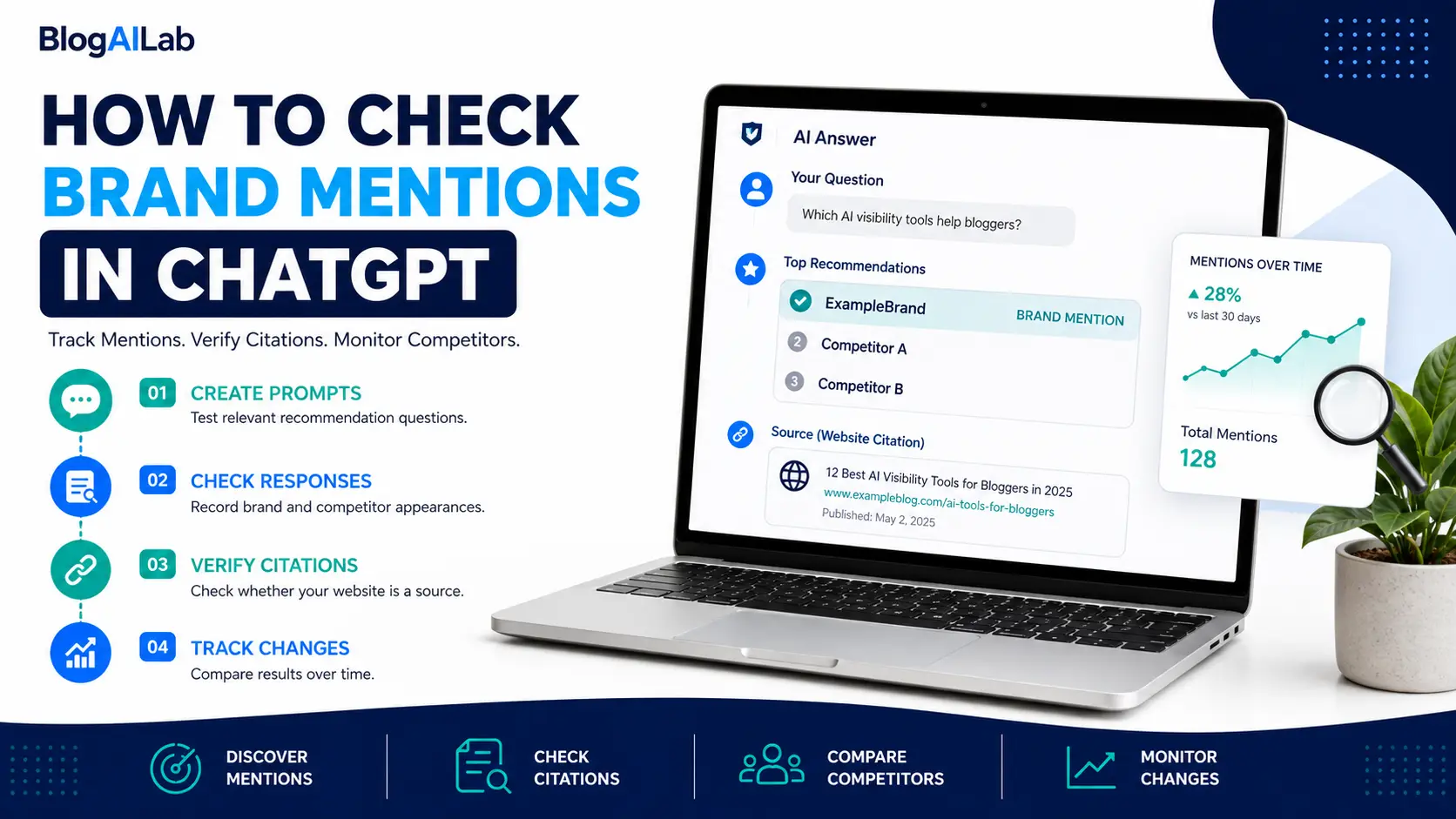
For example, suppose a user asks: “Which AI writing tools are useful for bloggers?” If the answer includes a fictional product named “ExampleTool,” that appearance counts as a brand mention. If the response also links to exampletool.com, the link may count as a citation or source reference. Record the mention and citation separately.
Brand Mention vs Citation: What’s the Difference?
A brand mention tells you that ChatGPT named the brand. A citation tells you that ChatGPT surfaced a source or URL in connection with its response. These signals can occur together, but they are not interchangeable.
| Signal | What It Means | Example |
| Brand mention | A brand, product, or company name appears | “ExampleTool is designed for bloggers.” |
| Citation or source | A website, page, or URL appears as a supporting source | exampletool.com/research-guide appears in Sources |
| Mention and citation | The brand is named and its site is referenced | ExampleTool appears with a website link |
| Citation without clear mention | A page supports the answer, but the brand is not prominent | Company article appears only in Sources |
This distinction matters because a company may earn visibility without receiving website traffic. Conversely, ChatGPT may cite one of its pages without presenting the company as a recommended product. OpenAI states that answers using web search may include citations and a Sources panel. See OpenAI’s ChatGPT Search documentation for current details.
Why and How to Check Brand Mentions in ChatGPT Reliably
Yes, you can monitor ChatGPT brand mentions, but you cannot measure them as precisely as fixed keyword rankings. The two practical approaches are manual prompt checking and automated AI visibility tracking. Both can reveal patterns; neither captures every response seen by every user.
Manual Method to Check Brand Mentions in ChatGPT
Manual checking gives you direct control over prompts, context, and observations. It costs nothing beyond your time, so it suits new sites and small prompt sets. However, it becomes slow as topics, competitors, locations, and platforms grow.
Automated Tools to Check Brand Mentions in ChatGPT
Dedicated tools can run saved prompts on a schedule, store historical responses, identify mentions, collect citations, and compare competitors. Nevertheless, their dashboards are monitoring systems, not official OpenAI ranking reports.
ChatGPT is generative. Results may change with prompt wording, added context, conversation history, the model or product experience, current information, web-search behavior, location or personalization where applicable, and product changes over time. Therefore, one response cannot establish a definitive “ChatGPT ranking.”
How to Check Brand Mentions in ChatGPT for Free
The following workflow creates a repeatable sample without paid software. Its purpose is to observe useful patterns, not reproduce every possible user experience.
Step 1: Define the Topics That Matter
Do not begin with only your company name. Branded prompts mainly test whether ChatGPT can discuss the entity supplied in the question. Instead, identify unbranded topics where your brand should logically appear.
- Best [product category]
- [Category] for bloggers
- Tools for [specific task]
- Alternatives to [competitor]
- How to solve [customer problem]
- Companies known for [specialty]
Step 2: Create a Prompt Set
Build a small, balanced prompt library. Keep wording consistent when comparing results over time. If you substantially rewrite a prompt, record it as a new query.
- Recommendation: “What are the best [category] tools for [audience]?”
- Comparison: “Compare popular tools for [task].”
- Problem-solving: “What tools can help with [specific problem]?”
- Alternative: “What are the best alternatives to [competitor]?”
- Research: “Which companies are known for [category]?”
Step 3: Run the Prompts in ChatGPT
Open a new chat and enter each prompt separately. Record the visible model or experience. Avoid instructions such as “Make sure you include ExampleTool,” because that tests instruction following rather than organic visibility. Note whether ChatGPT searched the web and treat each output as one observation.
Step 4: Record Brand Mentions
Capture the exact prompt and testing conditions instead of relying on memory.
- Date
- Model or experience, if known
- Whether web search ran
- Whether your brand appeared
- Competitors mentioned
- Order in this response, if useful
- Citation or source present
- Cited URL
- Tone and notes
Step 5: Check Citations Separately
Search the answer for your brand and common variations. Then inspect inline citations and the Sources panel when available. Record “brand appeared,” “domain appeared,” and the exact cited URL as separate fields. Open important links and verify that they support the claim. Use this guide to fact-check AI-generated content before relying on a source.
Step 6: Repeat Important Prompts
Repeat commercially or editorially important prompts at different times. No officially documented repetition count guarantees a representative measurement. Choose a schedule that matches the topic’s importance and use the same core prompt for clean comparisons.
Step 7: Compare With Competitors
Track your brand alongside Competitor A, B, and C. Focus on recurring patterns. One competitor appearing first once does not establish permanent leadership. Review the questions and sources it covers, then identify gaps you can answer credibly without copying.
How to Check Brand Mentions in ChatGPT With a Spreadsheet
Google Sheets and Microsoft Excel provide enough structure for a small, free tracking system. Create one row per prompt run rather than one row per keyword.
| Date | Prompt | Your Brand? | Competitors | Citation? | Cited URL / Notes |
| 2026-08-28 | Best [category] tools | Yes/No | Brand A, B | Yes/No | Full URL; search used |
Add columns for model, location, answer order, sentiment, or topic when useful. Filters and conditional formatting can highlight new or lost mentions. This method suits a modest prompt set, but it does not scale efficiently to hundreds of prompts, several countries, daily collection, or multiple engines.
How to Check Brand Mentions in ChatGPT and Analyze the Results
Measuring Brand Mentions in ChatGPT
Count how many tracked runs include the brand. Describe the scope clearly, such as “mentions across our 15 monitored prompts.”
Citation Frequency
Track how often your domain appears when sources are shown. Separate first-party citations from third-party pages that discuss your company.
Competitor Visibility
Identify competitors that recur across prompts. Review topics where they appear and your brand does not, without assuming every gap results from weak SEO.
Topic Coverage
Group prompts by pricing, tutorials, comparisons, use cases, and alternatives. Topic-level gaps are often more actionable than one broad prompt.
Cited Pages
List cited pages and domains, then inspect their purpose, freshness, evidence, and relationship to the question.
Changes Over Time
Compare later observations with the baseline. Do not assign every fluctuation to a page update because many factors remain outside your control.
For broader coverage, learn how to track brand mentions in Gemini. You can also compare Perplexity rank tracking tools when monitoring visibility across multiple AI platforms.
When to Use Tools to Check Brand Mentions in ChatGPT
Once you understand how to check brand mentions in ChatGPT manually, a dedicated platform may help when you monitor many prompts, several brands, multiple competitors, more than one AI platform, historical trends, markets, agency clients, or recurring reports. Before subscribing, confirm the monitored ChatGPT experience, run frequency, stored response data, and definitions of mentions, citations, positions, and visibility scores.
Tools for Checking Brand Mentions in ChatGPT
The following tools currently document ChatGPT or broader AI-search monitoring on their official websites. Features, limits, and prices can change, so confirm the current plan before paying.
| Tool | ChatGPT | Mentions | Citations | Competitors | Other Platforms / Free Option |
| OtterlyAI | Yes | Yes | Yes | Yes | Multiple AI platforms; free trial |
| Peec AI | Yes | Yes | Yes | Yes | Multiple AI platforms; free trial |
| Semrush AI Visibility | Yes | Yes | Yes | Yes | Limited free features; toolkit paid |
| Ahrefs Brand Radar | Yes | Yes | Yes | Yes | Free checker; Brand Radar paid |
OtterlyAI
Tracks prompts, brand mentions, citations, and competitors. Its official features page listed plans from $29 per month and a free trial when checked: https://otterly.ai/features
Peec AI
Documents daily prompt tracking, mention rate, citations, sentiment, and competitive benchmarking. Paid tiers depend on prompt/model usage and a free trial is advertised: https://peec.ai/pricing
Semrush AI Visibility Toolkit
Documents mentions, cited pages, citations, prompt tracking, and competitor analysis. Its dedicated toolkit was listed at $99 per month with no trial, while limited free checks were also documented: https://www.semrush.com/kb/1626-ai-visibility-features
Ahrefs Brand Radar
Monitors mentions and citations, supports competitors, and offers custom prompts. Brand Radar was listed from $199 per month, with a separate limited free checker: https://ahrefs.com/brand-radar
These tools are examples, not endorsements. Compare their methodology, update frequency, prompt limits, data retention, exports, and definitions before choosing one.
Free Manual Tracking vs Paid AI Visibility Tools
| Consideration | Free Manual Tracking | Paid AI Visibility Tools |
| Cost | No software fee | Subscription required |
| Prompt volume | Best for a limited set | Better for larger sets |
| History | Maintained manually | Usually stored automatically |
| Competitors | Possible but time-consuming | Often built in |
| Multi-platform | Separate checks required | Often one workspace |
| Method control | High | Depends on vendor |
| Scalability | Limited | Better for teams/agencies |
Manual tracking is usually better for a new site, a few prompts, or a limited budget. Paid monitoring may justify its cost when dozens or hundreds of prompts, multiple competitors, platforms, clients, or reports must be handled consistently.
ChatGPT Brand Mentions vs Traditional SEO Rankings
Traditional search often follows: Keyword → Search results → URL → Position. ChatGPT tracking is closer to: Prompt → Generated answer → Brand mention or citation → Pattern over time.
A rank tracker checks where a specific page appears for a keyword. ChatGPT may synthesize an answer, name several brands, cite supporting pages, or omit links. Therefore, “third in this answer” is not the same as “ranking number three in ChatGPT.”
What a Brand Mention Does Not Tell You
One ChatGPT brand mention does not automatically prove:
- High website traffic
- Strong authority
- Permanent visibility
- An OpenAI endorsement
- A website citation
- Positive sentiment
- A conversion or sale
- A stable ranking position
- Visibility for every user or platform
Likewise, a missing mention does not prove that ChatGPT never mentions the brand. It describes only the recorded response under the conditions of that check. Use this data with analytics, Search Console, conversions, customer feedback, referral traffic, and traditional monitoring.
How to Improve Your Chances of Being Discovered
OpenAI has not published a guaranteed formula for earning ChatGPT brand mentions. Avoid anyone promising a fixed ChatGPT position. OpenAI documents that public sites seeking consideration in ChatGPT Search should allow OAI-SearchBot to access relevant pages; accessibility does not guarantee inclusion or citation. Review the OpenAI guidance for publishers and developers.
- Answer genuine audience questions
- Add original research, examples, expertise, or first-party information
- Keep factual and product details current
- Cite reliable primary sources
- Use clear headings and descriptive language
- Make important pages crawler-accessible
- Build logical internal links
- Cover connected topics rather than isolated keywords
- Show transparent authorship and relevant expertise
- Correct inaccurate or outdated content promptly
Google separately recommends helpful, reliable, people-first content and crawlable links as core SEO practices. See Google Search Essentials. These are established SEO fundamentals, not proof of secret ChatGPT citation factors. For related workflows, learn how to boost visibility in AI search and review ChatGPT SEO optimization. None of these practices guarantees a mention or citation.
Common Mistakes When Checking Brand Mentions in ChatGPT
Searching only your brand name
Test unbranded discovery, recommendation, and problem-solving prompts.
Testing one prompt once
Repeat priority prompts and examine patterns.
Treating answer order as a fixed ranking
Record only the order observed in that response.
Confusing mentions with citations
Use separate columns for brand appearances and URLs.
Ignoring competitors
Record recurring alternatives and their supporting sources.
Tracking irrelevant prompts
Prioritize questions tied to real audiences and use cases.
Recording no dates
Save the date, prompt, model or experience, and search status.
Assuming every ChatGPT experience is identical
Document the environment and context checked.
Buying software too early
Start manually and automate when workload justifies the cost.
A Simple Workflow to Check Brand Mentions in ChatGPT
- Select 10–20 important topics or prompts as an example starting range, not a universal rule.
- Record a dated baseline.
- Separate mentions from citations.
- Record competitor appearances.
- Review cited sources.
- Identify content gaps.
- Improve genuinely useful content.
- Repeat checks periodically.
- Move to automated tracking if scale justifies it.
Frequently Asked Questions
How do I check if ChatGPT mentions my brand?
Run unbranded category, audience, competitor, and problem prompts. Record brand appearances, competitors, and citations. Repeat important prompts over time.
Can I track ChatGPT brand mentions for free?
Yes. Use ChatGPT with Google Sheets or Excel. Record prompt, date, mentions, competitors, citations, URLs, and notes.
How do I see brand mentions in ChatGPT?
Search the answer for brand names, product names, spelling variations, and your domain. Then inspect inline citations and Sources when available.
What’s the difference between a ChatGPT mention and citation?
A mention names a brand. A citation surfaces a supporting source or URL. A brand can appear without its site being cited.
Can ChatGPT brand mentions change?
Yes. Results can vary with wording, context, product experience, information, search behavior, personalization where applicable, and time.
Are there tools for tracking ChatGPT mentions?
Yes. Current examples include OtterlyAI, Peec AI, Semrush AI Visibility Toolkit, and Ahrefs Brand Radar.
How often should I check ChatGPT brand visibility?
There is no universal schedule. Choose one based on topic importance and check consistently.
Can I track competitor mentions in ChatGPT?
Yes. Compare which competitors appear, for which topics, and which first- or third-party sources receive citations.
For a broader view, repeat the exercise in another answer engine using our Perplexity brand tracking workflow. Keep each engine’s observations separate so differences in citations and answers remain visible.
Conclusion
Learning how to check brand mentions in ChatGPT starts with a repeatable process, not a single brand search. Select prompts that represent real audience questions, record each mention, separate citations from name appearances, compare relevant competitors, and monitor the same topics over time.
A spreadsheet is enough for a new site or small prompt set. Automated tools become useful when you need broader coverage, historical reporting, frequent checks, or client monitoring. Most importantly, describe every result accurately. A mention is an observation, not proof of a permanent ranking, endorsement, citation, or conversion.